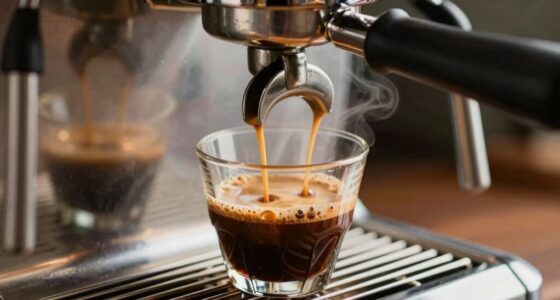
Your coffee’s flavor depends heavily on brewing variables like grind size, extraction, time, and water temperature. A coarse grind or quick brew can cause sour, under-extracted flavors, while a fine grind or prolonged brewing risks bitterness. Under or over-extraction also impacts the balance, making your coffee taste dull or off. Small adjustments to your technique can make a big difference, and there’s more to uncover to perfect your cup.

Get kitchen staples and gadgets delivered free — and shop member deals
- Fast, free delivery on millions of items
- Access to Prime Big Deal Days deals on October 6–7
- Prime Video, Amazon Music and more included
Key Takeaways
- Variations in grind size affect extraction level, leading to sourness with coarse grind or bitterness with fine grind.
- Brewing time impacts flavor; short times cause sourness, while long times result in bitterness.
- Water temperature influences extraction; cooler water may cause sourness, hotter water can produce bitterness.
- Inconsistent technique adjustments, like changing brew time or grind, alter flavor even with the same coffee bag.
- Proper control of brewing variables ensures balanced extraction and consistent flavor from the same beans.

If your coffee tastes sour, bitter, or empty, there’s often a simple explanation behind it. These flavor issues usually stem from how the coffee’s flavor development interacts with your brewing techniques. Coffee’s flavor profile is highly sensitive to variables like grind size, water temperature, and extraction time. When these aren’t aligned, the resulting brew can taste off, even if it comes from the same bag you’ve been using. Understanding how your brewing techniques influence flavor development is key to achieving a balanced, pleasant cup.
Small changes in brewing techniques can transform sour, bitter, or empty-tasting coffee into a perfectly balanced cup.
Sourness often results from under-extraction, which happens when water doesn’t extract enough of the coffee’s soluble compounds. This can occur if you grind the beans too coarsely or brew too quickly, leading to a weak, underdeveloped flavor. Conversely, bitterness can come from over-extraction, where extraction continues too long or the grind is too fine, pulling out undesirable compounds. An over-extracted brew can taste harsh, astringent, or empty, lacking the nuanced sweetness you’re aiming for. Both extremes highlight how essential the control of brewing techniques is to proper flavor development.
The key to avoiding these issues is adjusting your brewing process based on the coffee’s characteristics. If you notice sourness, try a finer grind or extend the brewing time slightly to allow more compounds to be extracted. For bitterness, consider a coarser grind or shorter brew time to prevent over-extraction. Each adjustment influences how the beans’ flavors develop during brewing, emphasizing the importance of precision. Coffee beans are complex, and their flavor can change even within the same bag depending on how you prepare them. Small changes in brewing techniques can make a significant difference in balancing acidity, sweetness, and bitterness.
Additionally, water temperature plays a pivotal role in flavor development. Too hot, and you risk over-extraction, resulting in bitterness; too cool, and you might under-extract, leading to sourness or a dull, empty taste. Aim for a water temperature around 195-205°F (90-96°C) to optimize extraction. Consistent, careful attention to these details ensures your coffee’s flavor profile is well-developed and enjoyable. Proper temperature control can influence extraction and ultimately the taste quality of your brew.
In short, understanding and controlling your brewing techniques allows you to influence how flavors develop from the same coffee beans. Small adjustments can prevent sour, bitter, or empty tastes, helping you craft a balanced, flavorful cup every time.
coffee grinder with adjustable grind size
As an affiliate, we earn on qualifying purchases.
As an affiliate, we earn on qualifying purchases.
Frequently Asked Questions
Can Storage Temperature Affect Coffee Flavor?
Yes, storage temperature affects coffee flavor. If you store your coffee too warm, it can accelerate staling and diminish flavor. Keep it cool and consistent to preserve freshness. Roast level also matters; lighter roasts are more sensitive to temperature changes. Additionally, low storage humidity helps prevent mold and flavor loss, while high humidity can cause the beans to absorb moisture, leading to sour or stale tastes. Proper storage keeps your coffee tasting its best.
Does Grind Size Influence Sour or Bitter Taste?
Think of your grind size as the brushstrokes of a painting—fine for smooth details, coarse for bold textures. When particle size varies, it creates uneven extraction, making your coffee taste sour or bitter. Consistent grind size and uniform particle size guarantee balanced flavors, like a symphony where each note harmonizes. So, refining your grind consistency helps you avoid unwanted sour or bitter notes, turning every cup into a masterpiece.
How Does Brewing Time Impact Coffee’s Flavor Profile?
Brewing time directly impacts your coffee’s extraction balance, shaping its flavor profile. If you brew too short, you’ll get under-extraction, resulting in sour, weak flavors. Too long, and over-extraction causes bitterness and loss of nuanced flavors. Finding the perfect brewing time guarantees ideal extraction, balancing acidity, sweetness, and bitterness. This enhances flavor complexity, giving you a richer, more satisfying cup every time. Adjust your brew time to fine-tune your coffee’s taste.
Can Water Quality Change the Coffee’s Taste?
Imagine pouring crystal-clear water into your coffee; its mineral content and pH level shape the flavor. High mineral content can make your brew taste metallic, while a low pH level might add sourness. If your water’s too soft or hard, it can mute or intensify flavors. So, yes, water quality profoundly impacts your coffee’s taste, transforming each sip from flat to vibrant or bitter to smooth.
Is Freshness the Main Factor in Coffee Taste Variations?
Yes, freshness is the main factor in coffee taste variations. When coffee is fresh, it offers better flavor stability, preserving nuanced aromas and flavors. As it ages, these flavors deteriorate, leading to dull or off-putting tastes. Your roast level also influences this; lighter roasts tend to lose freshness faster, while darker roasts can maintain flavor stability longer. So, storing coffee properly and consuming it quickly helps guarantee the best taste experience.
digital coffee thermometer for brewing
As an affiliate, we earn on qualifying purchases.
As an affiliate, we earn on qualifying purchases.
Conclusion
Understanding why your coffee can taste different from the same bag helps you enjoy it more. Did you know that brewing variables, like water temperature and grind size, can change flavor profiles dramatically? In fact, a study found that adjusting brewing methods can improve flavor consistency by up to 50%. So next time your coffee tastes off, tweak your process—small changes can make a big difference in achieving that perfect, balanced cup you crave.
As an affiliate, we earn on qualifying purchases.
As an affiliate, we earn on qualifying purchases.
NFL season / tailgating Picks
team gear
As an affiliate, we earn on qualifying purchases.