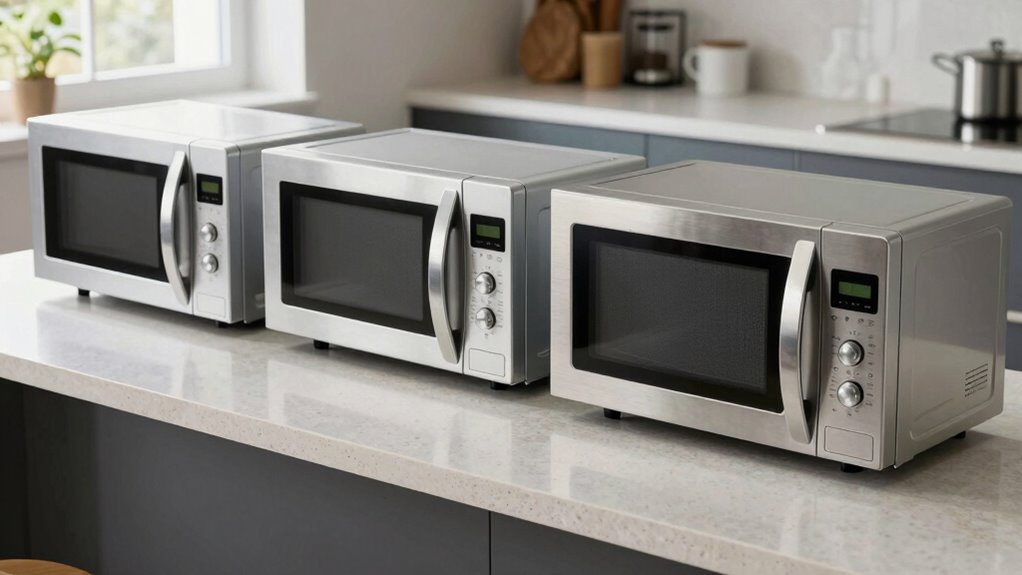

To choose the right microwave size, consider your capacity needs, your kitchen space, and daily routines. Smaller models (0.7-1.0 cu ft) fit countertops well for basic reheating, while larger ones (1.2+ cu ft) handle bigger meals. Be mindful of footprint and placement, especially in tight spaces, and opt for models that balance functionality with convenience. Want to learn how to measure for the perfect fit and maximize efficiency? Keep exploring for detailed tips.

Get kitchen staples and gadgets delivered free with Prime
- Fast, free delivery on millions of items
- Prime Video, Amazon Music and more included
- Member-only deals all year
Key Takeaways
- Match microwave capacity (0.7 to 1.2+ cubic feet) with typical cooking and reheating needs.
- Measure available space carefully, including ventilation clearance, to ensure proper fit and safety.
- Consider kitchen layout and placement options, such as countertop, wall-mounted, or corner models.
- Balance size with energy efficiency, opting for smaller models for casual use and larger for extensive cooking.
- Prioritize user accessibility, ensuring controls and door operation suit daily routines and kitchen workflow.
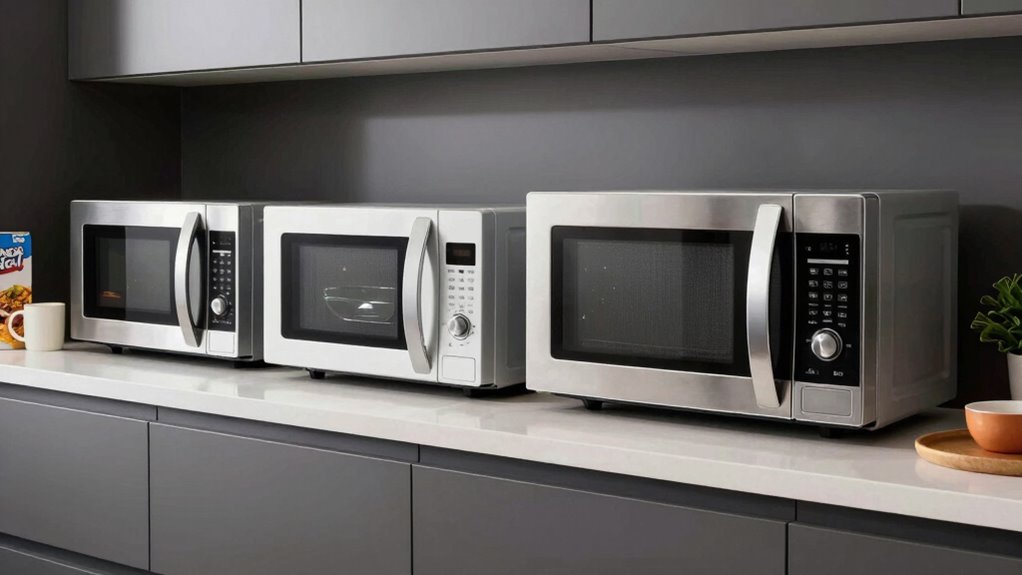
Choosing the right microwave size is essential to guarantee it fits seamlessly into your space and meets your cooking needs. When you consider your kitchen space, think about both the footprint and the layout. A larger microwave offers more capacity and flexibility but can dominate a small countertop, making your space feel cramped. Conversely, a compact microwave might save room but limit what you can cook or reheat. Measure carefully before purchasing, ensuring there’s enough clearance for opening the door comfortably and for proper ventilation. Remember, leaving some space around the microwave helps prevent overheating and maintains its energy efficiency.
Speaking of energy efficiency, a smaller microwave generally uses less power because it heats smaller quantities more quickly. If you typically reheat single servings or small meals, a compact model can be highly energy-efficient, saving you money on electricity bills. Larger models, while convenient for cooking multiple items or larger dishes, tend to consume more energy, especially if you frequently operate at full capacity. So, consider how often you’ll be using the microwave for larger meals versus quick reheats. Choosing an energy-efficient size not only benefits your utility bills but also reduces your environmental footprint. It’s also beneficial to consider the environmental impact, as smaller appliances generally contribute less to resource consumption during manufacturing and use.
When evaluating capacity, look beyond just the volume number. Think about what you usually cook or reheat. A microwave with a capacity of around 0.7 to 1.0 cubic feet fits most everyday needs, like reheating leftovers or cooking snacks. If you often prepare larger meals or use cookware that requires more space, a model with 1.2 cubic feet or more might be better. Keep in mind that larger capacities mean a bigger footprint, so ensure your kitchen space can accommodate the size comfortably without overcrowding. Additionally, considering appliance placement can help you select a model that fits well within your kitchen layout.
Real-world use also plays a role. If your kitchen has limited counter space, a microwave with a smaller footprint mounted on a wall or integrated into cabinetry might be the best choice. Think about accessibility too—if multiple people use the microwave, a model with a user-friendly interface and easy-to-open door can make a big difference. Also, consider the placement—corner models or those with unique shapes can help maximize space in tight kitchens. Ultimately, selecting the right size involves balancing capacity needs, kitchen space, and energy efficiency, ensuring your microwave fits well into your daily routine without sacrificing functionality or comfort.
compact microwave oven 0.7 cubic feet
As an affiliate, we earn on qualifying purchases.
As an affiliate, we earn on qualifying purchases.
Frequently Asked Questions
How Energy-Efficient Are Different Microwave Sizes?
Larger microwaves tend to consume more energy due to increased capacity and power output, but their appliance efficiency can vary. Smaller models often use less energy, making them more energy-efficient for quick tasks. However, if you frequently cook larger portions, a bigger microwave might be more efficient overall. Focus on selecting a microwave with an energy-efficient rating to balance energy consumption and performance, regardless of size.
Can Larger Microwaves Fit in Small Kitchens?
You can absolutely squeeze a larger microwave into a small kitchen, but beware—their massive size might overshadow your countertop aesthetics! These giants often demand significant countertop clearance, making your space feel even tinier. While they offer impressive capacity, you’ll need to carefully measure your available space to guarantee it fits without cramping your style. Think of it as fitting a spaceship into a shoebox—possible, but not without some creative rearranging!
Do Bigger Microwaves Consume More Electricity?
Yes, bigger microwaves generally consume more electricity because their higher power ratings mean they use more energy during operation. When comparing energy consumption, look at the microwave’s wattage; higher wattage indicates more power use. However, actual energy use also depends on how often and how long you run the microwave. So, larger models might cost a bit more to operate, especially if used frequently.
Are Compact Microwaves Suitable for Family Use?
Yes, compact microwaves can be suitable for family use if you prioritize family convenience and don’t need to cook large meals at once. Their compact design makes them ideal for small kitchens and quick tasks, but they may have limited capacity. If your family often cooks or reheats larger portions, consider a slightly bigger microwave. Otherwise, compact models can still meet everyday needs efficiently, especially for busy households.
How Does Microwave Size Affect Cooking Performance?
A microwave’s size subtly influences its cooking prowess. Larger models often boast more microwave power, enhancing cooking speed and efficiency. They also tend to deliver better cooking uniformity, reducing cold spots and ensuring your food heats evenly. Smaller units might be less powerful, which can mean longer cooking times or uneven results. So, choosing the right size helps you achieve consistent, delicious dishes with ease, making your kitchen experience more enjoyable.
large capacity microwave 1.2 cubic feet
As an affiliate, we earn on qualifying purchases.
As an affiliate, we earn on qualifying purchases.
Conclusion
Choosing the right microwave size might seem tricky, but it’s all about understanding your needs. Don’t worry if your space feels tight—compact models can still pack a punch for everyday use. Remember, bigger isn’t always better; it’s about finding the perfect fit for your kitchen and lifestyle. Take your time to measure, consider your typical cooking habits, and you’ll confidently select a microwave that works seamlessly for you.
wall-mounted microwave for small kitchens
As an affiliate, we earn on qualifying purchases.
As an affiliate, we earn on qualifying purchases.
energy-efficient countertop microwave
As an affiliate, we earn on qualifying purchases.
As an affiliate, we earn on qualifying purchases.
NFL season / tailgating Picks
team gear
As an affiliate, we earn on qualifying purchases.