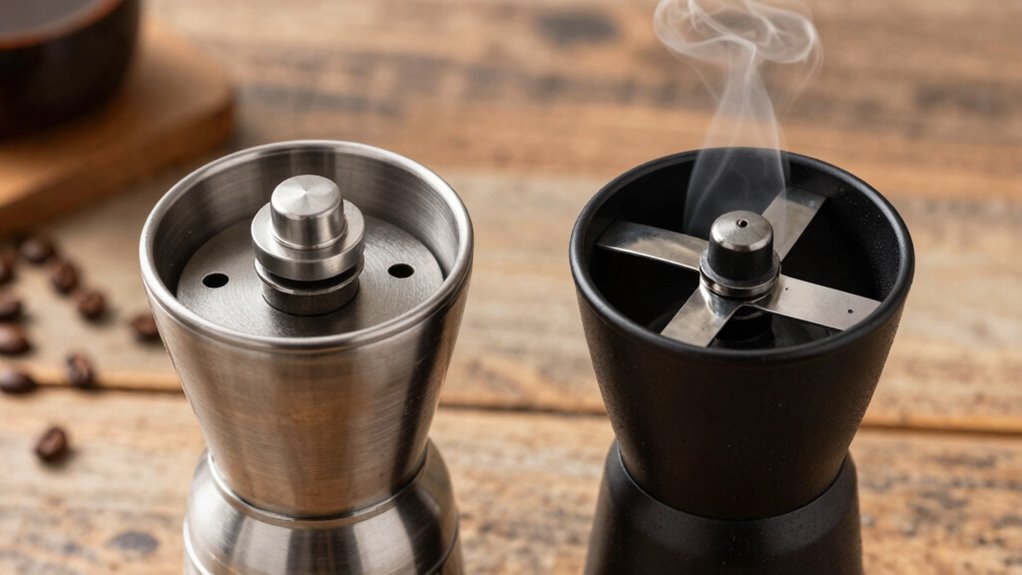

Choosing between a burr and blade grinder affects your coffee’s flavor and aroma. Burr grinders crush beans uniformly, ensuring consistent grind size that leads to better extraction and richer taste. Blade grinders chop beans unevenly, causing inconsistent flavors and weaker aroma. Proper grind size and consistency are key to a balanced coffee. Want to know how to get the most flavor from your grinder? Keep exploring for simple tips to improve your brew.
Key Takeaways
- Burr grinders produce uniform, consistent grounds that enhance flavor extraction and aroma preservation, unlike the uneven particles from blade grinders.
- Blade grinders chop beans randomly, causing inconsistent grind sizes that lead to uneven extraction and duller coffee flavor.
- Precise adjustments on burr grinders allow for tailored grind sizes suited to different brewing methods, improving overall flavor quality.
- Regular cleaning and maintenance of burr grinders maintain grind consistency, ensuring optimal flavor and aroma over time.
- Upgrading from blade to burr grinders significantly improves coffee clarity, richness, and overall taste experience.
What Are Burr and Blade Coffee Grinders?
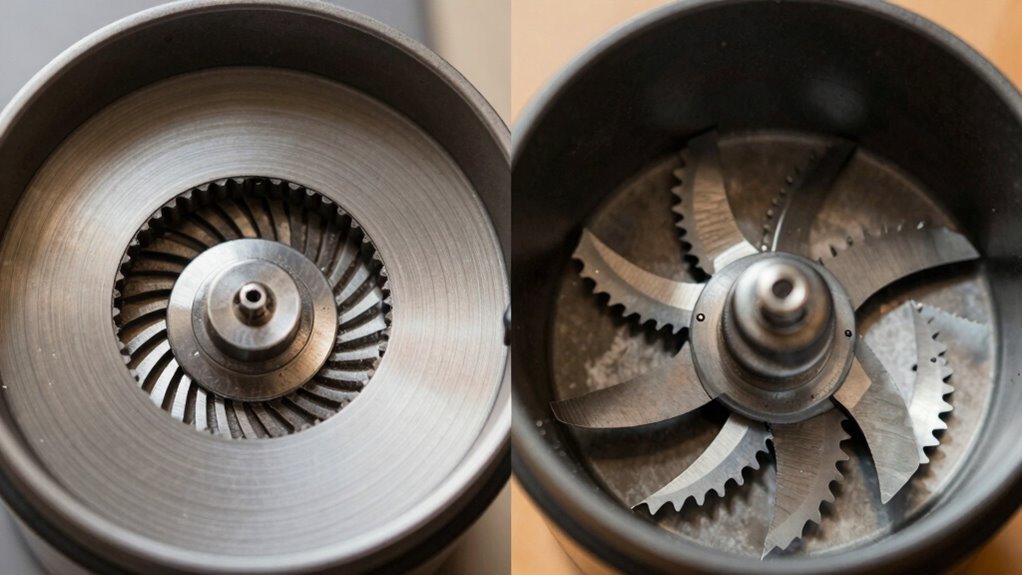
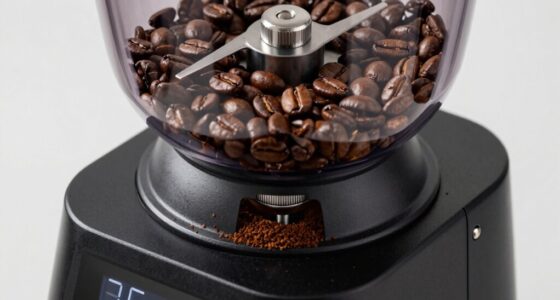
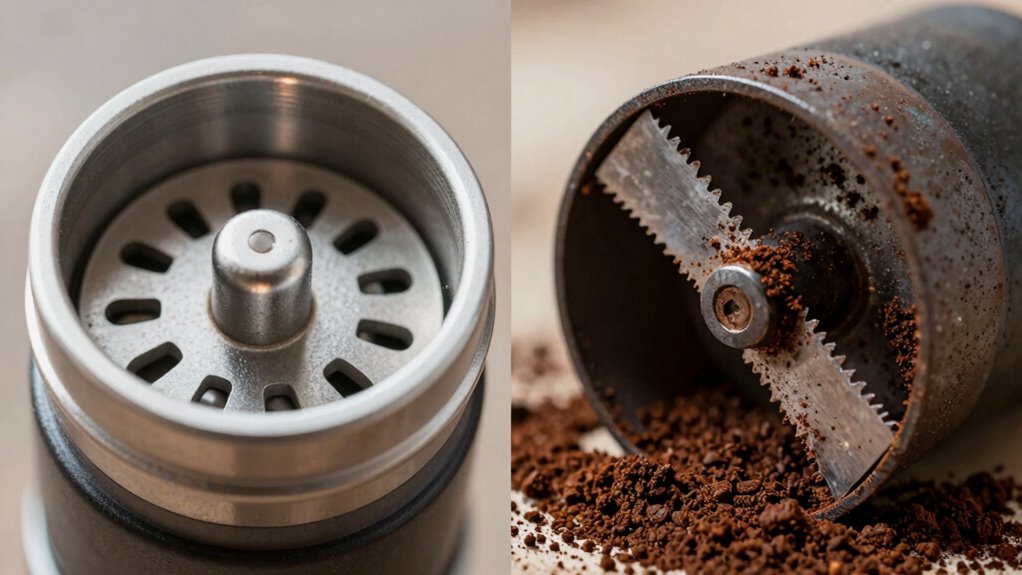
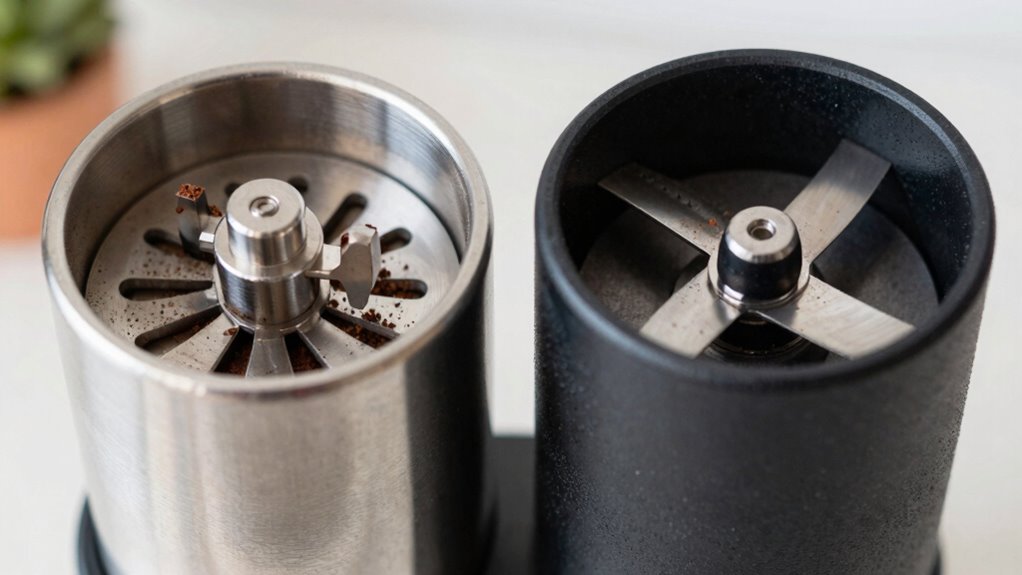
When it comes to grinding your coffee beans, understanding the difference between burr and blade grinders is essential. Burr grinders use two abrasive surfaces to crush beans uniformly, resulting in consistent grounds. They tend to be quieter and produce less grinder noise, making them more suitable for quiet mornings. Additionally, grind consistency plays a crucial role in extracting the best flavor from your coffee. Burr grinders also typically offer more precise adjustment settings, allowing for more control over the grind size. Blade grinders, on the other hand, have sharp blades that spin quickly to chop beans unevenly. They’re typically louder, creating more grinder noise, and can produce inconsistent grounds. Cleaning methods also differ; burr grinders require regular brushing to remove coffee residue, while blade grinders are easier to clean but may need more frequent cleaning to prevent flavor transfer. Choosing the right grinder depends on your preferences for noise levels, maintenance, and grind consistency. Furthermore, grinder technology influences the overall quality and durability of your coffee grinder. Plus, coffeebrewing methods can impact which grinder type is most suitable for your brewing style.
How Do Burr Grinders Create Consistent Coffee Grounds?
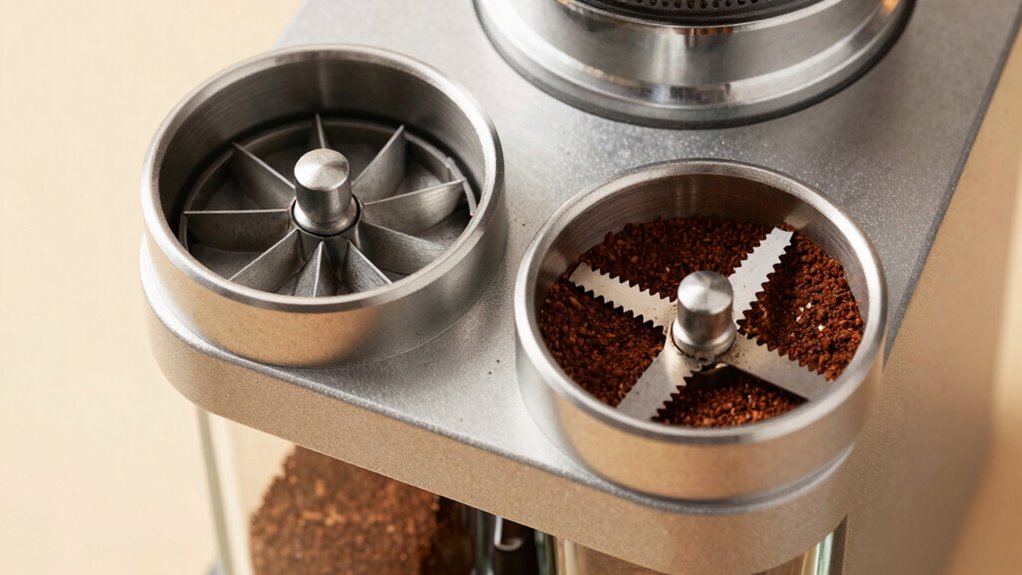
Burr grinders produce consistent coffee grounds by creating a uniform particle size. You can also fine-tune your grind with precise settings to match your brewing method. This control helps make certain your coffee brews evenly and tastes great every time. Proper maintenance can prevent common issues and extend the lifespan of your grinder repair fundamentals. Additionally, essential oils for coffee flavor can be used to enhance aroma and taste, offering a more enjoyable brewing experience. Using the right luggage & bags can also help keep your equipment safe and accessible during travel. Being aware of Youngster Choice can inspire you to explore more about personal journeys and success stories in the coffee industry.
Uniform Particle Size
Unlike blade grinders, burr grinders produce uniform coffee grounds by forcing beans between two precisely adjusted grinding surfaces. This design ensures each grind particle is consistently sized, which is vital for even extraction. When you operate a burr grinder, the beans are crushed gradually, preventing uneven pieces that can occur with blades. The consistent force applied across the beans results in a grind particle with uniform size, which directly impacts flavor and brewing quality. Because the grind is uniform, extraction happens more evenly, reducing bitterness or weak spots in your coffee. This precision allows you to fine-tune your grind settings for different brewing methods. Overall, burr grinders deliver a predictable, consistent grind that enhances your coffee’s flavor and aroma. Additionally, the ability to control grind size precisely is essential for achieving optimal flavor extraction in various brewing techniques. For example, adjusting the grind size can significantly influence the strength and clarity of your brewed coffee.
Precise Grind Settings
Precise grind settings are essential for achieving consistent coffee grounds, and burr grinders excel in this area through their adjustable mechanisms. By turning a dial or lever, you can fine-tune grind size with remarkable accuracy, ensuring each brew is consistent. This level of control allows you to make grind setting adjustments tailored to your brewing method, whether it’s espresso, pour-over, or French press. Burr grinders produce uniform particles, which is key for precision brewing, as it helps extract flavors evenly and reduces bitterness. Unlike blade grinders, which lack this precision, burr grinders give you the ability to dial in the perfect grind size. This consistency not only improves flavor but also makes your brewing process more predictable and enjoyable. Additionally, understanding flow rate and water quality can further optimize your coffee extraction process.
How Do Blade Grinders Work, and Why Do They Vary in Grind Size?
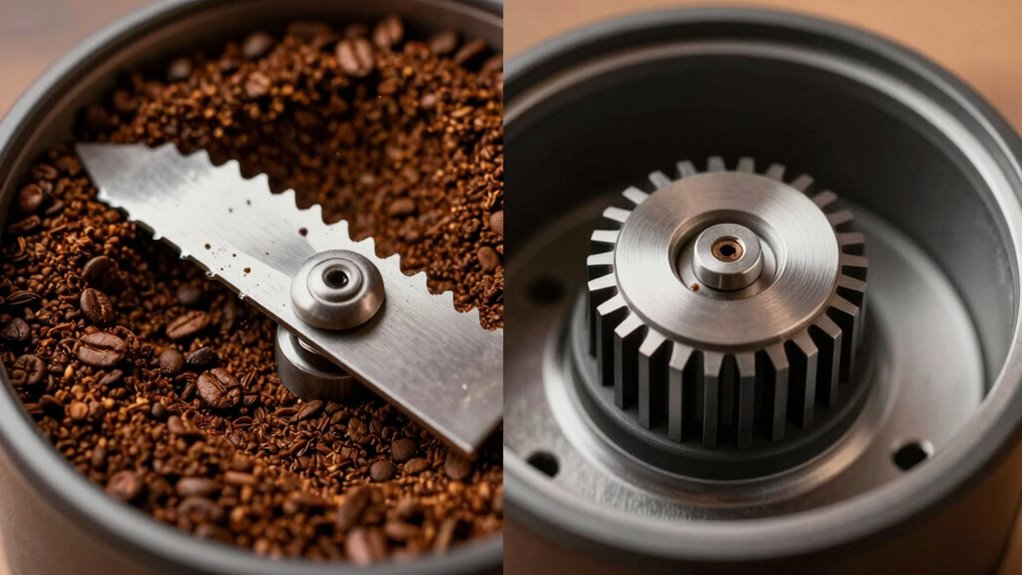
Blade grinders work by using one or more spinning blades to chop coffee beans into smaller particles. This method leads to grind size variability because the blades don’t cut uniformly; instead, they crush and tear beans into uneven pieces. The size of these particles depends on how long you grind and the blade’s sharpness considerations. Dull blades tend to produce more inconsistent grinds, as they struggle to cut cleanly through beans. Additionally, the blades spin at high speeds, creating a pulverizing effect that results in a mixture of fine dust and larger chunks. Since the process isn’t precise, your grind size can vary markedly, affecting extraction and flavor. That’s why blade grinders are often less consistent than burr grinders. Also, the material of the blades can influence how well they perform over time, impacting grind quality. Furthermore, the lack of uniformity in particle size can lead to uneven extraction, which may negatively influence your coffee’s flavor profile.
Which Preserves More Coffee Aromas: Burr or Blade?
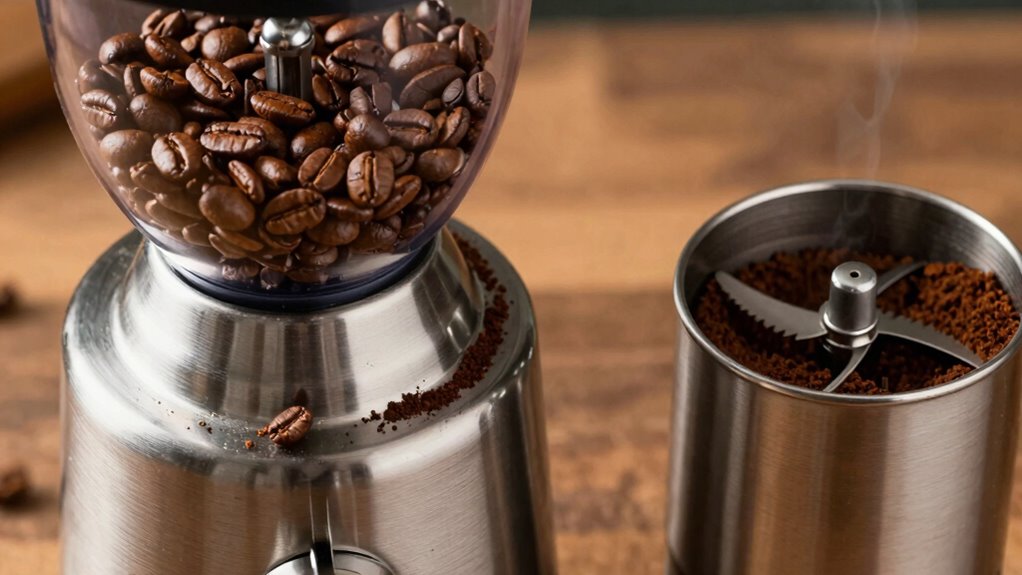
When it comes to preserving coffee’s rich aromas, burr grinders generally outperform blade grinders. Burr grinders produce a consistent grind size, which helps retain more delicate aromatic compounds during brewing. Blade grinders, on the other hand, often generate uneven grounds, causing some aromas to dissipate quickly. Additionally, burr grinders tend to operate more quietly, reducing grind noise that can disturb your brewing process and aroma preservation. They also have simpler cleaning routines, making it easier to remove residual oils and particles that can dull flavors over time. Proper cleaning guarantees the grinder remains in excellent condition, helping to preserve those subtle aromas. Moreover, grind uniformity plays a crucial role in ensuring a balanced extraction that maximizes flavor and aroma retention. Regular maintenance of burr grinders, including cleaning routines, can significantly extend their effectiveness and aroma-preserving capabilities. Overall, investing in a burr grinder not only improves grind consistency but also better preserves the full spectrum of coffee’s enticing aromas.
How Does Grind Uniformity Affect Coffee Extraction and Flavor?
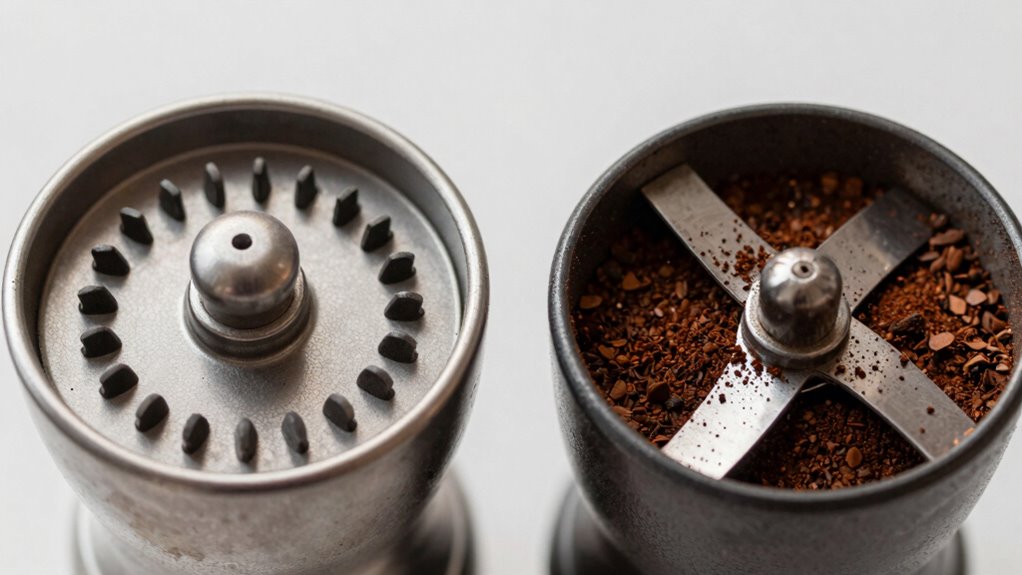
Consistent grind size plays a vital role in how evenly coffee extracts during brewing. When particle size is uniform, water flows through the grounds more evenly, enhancing brewing efficiency. If particles vary in size, larger chunks slow water flow, leading to under-extraction, while smaller particles can cause over-extraction and bitterness. Uniform grind size ensures that all coffee particles dissolve at a similar rate, resulting in a balanced flavor profile. Better particle size consistency also reduces the risk of channeling, where water bypasses some grounds. This improves extraction efficiency, allowing you to extract maximum flavor with less waste. Additionally, using properly maintained equipment such as burr grinders helps achieve this uniformity more effectively. Achieving consistent grind size not only improves flavor but also minimizes misinformation about brewing techniques, ensuring you get the best possible cup every time. Regular calibration of grinders is essential to maintain grind consistency over time. Incorporating quality burr grinders can significantly impact the overall consistency of your grind size. In short, a consistent grind directly influences the quality of your brew, making it more flavorful, aromatic, and enjoyable. Moreover, understanding the impact of grind uniformity on extraction can help you make more informed brewing decisions.
How Easy Are Burr and Blade Grinders to Use and Maintain?
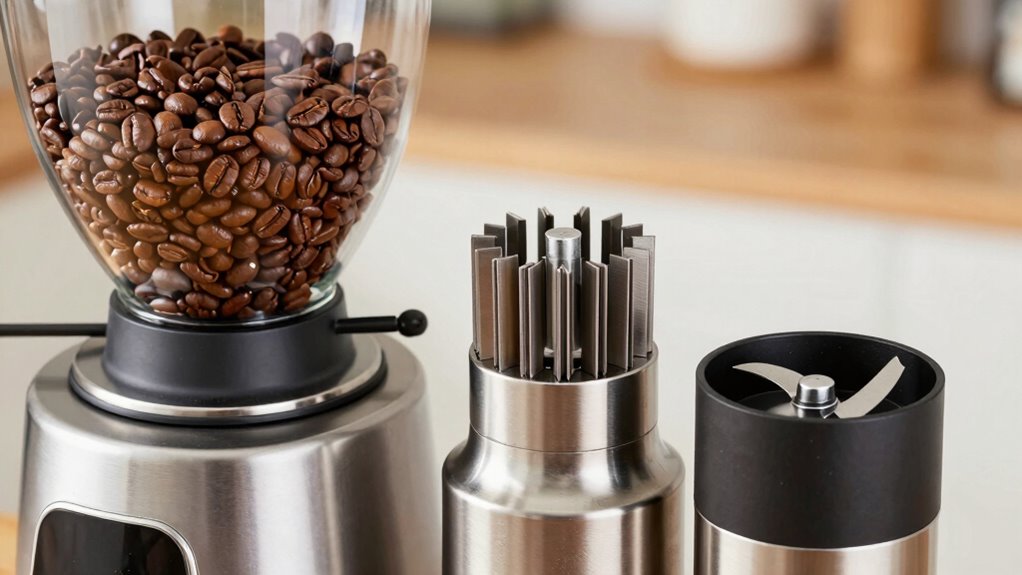
Burr grinders are generally straightforward to operate and maintain, making them a popular choice for many home baristas. You’ll find that daily maintenance, like grinder cleaning, is simple and essential for consistent performance. To keep your grinder in top shape:
Burr grinders are easy to operate and maintain for consistent, long-lasting performance.
- Regularly remove and clean the burrs to prevent buildup
- Wipe down the exterior with a damp cloth
- Use a brush to clear out loose grounds from the hopper and chute
- Follow manufacturer instructions for deep cleaning schedules
Blade grinders require less maintenance but can be messier during grinding and cleaning. Burr grinders may take a bit more effort initially, but their ease of use and durability make them worth it. Proper daily maintenance ensures ideal flavor and longevity.
What’s the Best Grinder for Different Brewing Methods?
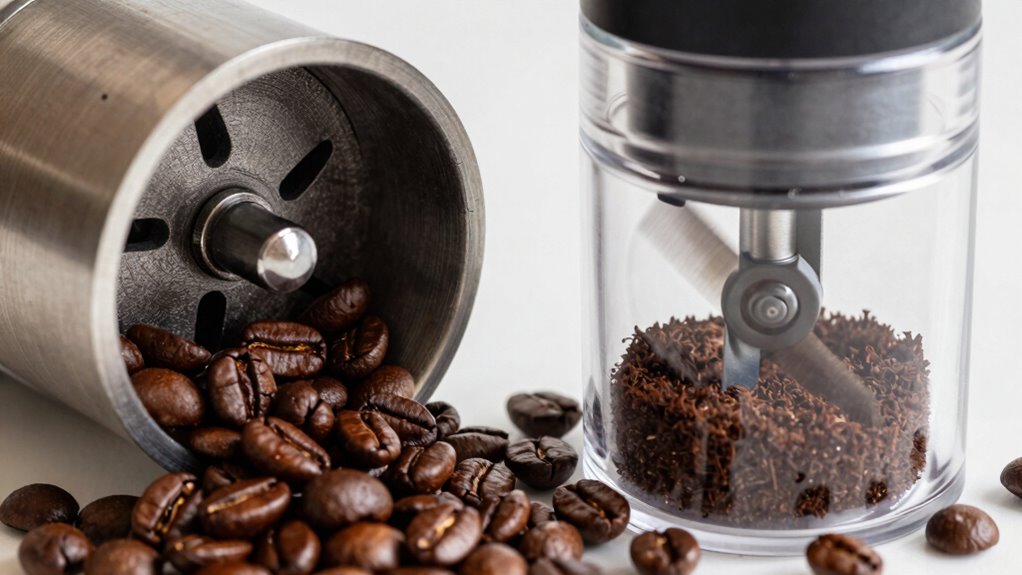
Choosing the right grinder depends on factors like grind size precision, which affects how your coffee brews. Consistency of grounds guarantees each cup tastes just right, while portability and price can influence your overall choice. Consider these points to find the best grinder for your preferred brewing method.
Grind Size Precision
Selecting the right grind size is essential because different brewing methods require specific particle textures to reveal the best flavor. Precise grind size ensures ideal extraction and enhances your coffee experience. When choosing a grinder, consider how well it controls particle size and uniformity.
- For espresso, opt for a fine, consistent grind to maximize extraction.
- French press calls for a coarse, uniform grind to prevent over-extraction.
- Pour-over brewing needs a medium grind with good particle uniformity for even extraction.
- AeroPress can handle a range from fine to medium, depending on your taste preference.
A grinder with precise control over particle size helps you achieve the perfect grind size for each method, improving flavor clarity and consistency. Remember, particle uniformity directly impacts your brew’s strength and flavor profile.
Consistency of Grounds
To achieve consistent grounds for your brew, it’s vital to find a grinder that delivers uniform particle sizes tailored to your brewing method. Good grind size uniformity ensures each particle extracts evenly, resulting in balanced flavor. Particle distribution plays an important role here; a grinder that produces a narrow range of grind sizes minimizes over-extraction or under-extraction. Burr grinders excel in this area, offering precise control and consistent results. Blade grinders, on the other hand, often produce uneven particle distribution, leading to inconsistent flavors. For techniques like espresso or pour-over, uniformity is key to optimize extraction. By prioritizing grind size uniformity and even particle distribution, you can improve your coffee’s flavor profile and achieve more predictable brewing outcomes.
Portability and Price
When considering a coffee grinder, your choice should align with your brewing method, budget, and lifestyle. If portability matters, look for portable options that are lightweight and compact, perfect for travel or small spaces. These grinders often come at a higher price but offer convenience on the go. Budget constraints influence your options: entry-level grinders are usually less expensive but may sacrifice grind consistency. Mid-range models balance price and performance, suitable for most brewing methods. High-end grinders, though pricier, provide superior grind quality and durability, ideal for serious coffee enthusiasts. Keep in mind:
- Portable options enhance travel convenience
- Price considerations vary based on features
- Larger, stationary grinders often cost more
- Balance your needs with your budget for the best fit
What Common Mistakes Should You Avoid With Your Coffee Grinder?
Avoid common mistakes that can compromise your coffee’s flavor and your grinder’s lifespan. One mistake is neglecting proper coffee storage; stale beans or moisture can affect grind quality and taste. Always store beans in an airtight container away from light and heat. Another mistake is skipping regular grinder cleaning. Residual grounds and oils build up, leading to inconsistent grinds and potential mold growth. Clean your grinder periodically according to the manufacturer’s instructions to maintain performance. Also, avoid grinding too much coffee at once, which strains the motor and accelerates wear. Finally, don’t use oily or flavored beans in a burr grinder unless it’s designed for them, as oils can clog the burrs. Staying mindful of these mistakes helps ensure fresh flavor and extends your grinder’s life.
How Do You Choose the Right Grinder for Your Budget and Tastes?
Choosing the right grinder depends on balancing your budget with your taste preferences. If you want consistent flavor, consider investing in a burr grinder, but if you’re on a tight budget, a blade grinder can work temporarily. To make a smart choice, think about:
Choosing the right grinder balances budget, flavor, and maintenance for better coffee.
- How often you’ll use it, to weigh durability against cost
- Your preferred coffee styles, influencing grind precision needs
- Ease of grinder maintenance, to keep performance steady
- Proper coffee storage, which preserves flavor and extends grinder life
Does Upgrading Your Grinder Really Improve Your Coffee Flavor?

Upgrading your grinder can make a noticeable difference in your coffee’s flavor, mainly because of improved grind consistency. You’ll also notice better flavor extraction when the grind size is more uniform, especially with burr grinders. Switching from a blade to a burr grinder can further enhance these benefits, leading to richer, more balanced coffee.
Grind Consistency Matters
When your coffee grounds aren’t consistent in size, it can lead to uneven extraction, resulting in a less balanced and flavorful brew. High grind size variability means some particles extract too quickly while others under-extract, diminishing flavor clarity. A good grinder minimizes this variability, ensuring uniform grounds. You’ll also notice that grinder noise levels can hint at performance—louder models often struggle with consistency. Upgrading can improve your results by reducing these issues. Consider these points:
- Consistent grind size ensures even extraction
- Lower grind size variability enhances flavor clarity
- Quieter grinders often produce more uniform grounds
- Better grind consistency saves time during brewing
Choosing a grinder that minimizes grind size variability makes a noticeable difference in your coffee’s taste and quality.
Flavor Extraction Differences
If your grinder produces inconsistent grounds, it can substantially impact how evenly your coffee extracts. Uneven grounds lead to uneven extraction, which diminishes aroma preservation and skews flavor profiling. A high-quality grinder, especially a burr grinder, creates uniform particles that allow hot water to extract flavors more consistently. This results in a more balanced, vibrant cup with preserved aromatic nuances. Conversely, a blade grinder’s inconsistent grounds can cause over-extraction of some particles and under-extraction of others, dulling flavor and reducing aroma. Upgrading your grinder makes a noticeable difference in flavor extraction, giving you greater control over the final taste. Better grind uniformity enhances aroma retention and ensures your brewing method brings out the true character of your coffee beans.
Burr vs Blade Impact
Choosing the right grinder can substantially affect your coffee’s flavor, and understanding the differences between burr and blade grinders helps clarify whether upgrading makes a real impact. Burr grinders produce a consistent grind size, reducing uneven extraction, which enhances flavor. They tend to be quieter and easier to clean, supporting better cleaning routines over time. Blade grinders, however, often generate more grinding noise and inconsistent grounds, which can lead to uneven flavor extraction. Upgrading to a burr grinder usually results in:
- Smoother, more uniform coffee flavor
- Reduced grinding noise
- Easier cleaning routines
- Better control over grind size
Investing in a burr grinder can significantly improve your coffee experience, especially if you value flavor clarity and consistency.
Frequently Asked Questions
How Does Grind Size Impact Brewing Time and Extraction Efficiency?
Smaller, uniform grind sizes improve extraction efficiency by increasing surface area, which speeds up brewing time and enhances flavor. When your grind size is consistent, it guarantees a steady extraction rate influence, preventing over- or under-extraction. Conversely, larger or inconsistent grinds slow down brewing and can result in uneven flavor. So, maintaining a consistent grind size helps you control both brewing time and extraction, leading to a better-tasting cup.
Can a Burr Grinder Produce Inconsistent Grounds Over Time?
A burr grinder can produce inconsistent grounds over time if you neglect proper maintenance, because “a chain is only as strong as its weakest link.” Regular cleaning and adjusting help maintain grind uniformity, preventing the build-up of residue that causes uneven particle sizes. Without this upkeep, you’ll notice inconsistency in your grounds, which impacts flavor extraction. So, stay on top of maintenance frequency to keep your grind consistent.
Are There Specific Cleaning Routines for Different Grinder Types?
Yes, you should follow specific cleaning routines for different grinder types. Maintain your grinder by sticking to regular maintenance schedules, like cleaning every few weeks. Use appropriate cleaning tools, such as brushes for burrs or compressed air for blades, to remove coffee residues. For burr grinders, disassemble and clean the burrs regularly, while blade grinders need simple wiping. Proper cleaning keeps your grinder consistent and guarantees ideal flavor extraction.
How Does Environmental Humidity Affect Coffee Grind Stability?
Humidity effects can cause your coffee grind to clump or become uneven, making dosing and extraction tricky. To minimize this, store your beans and grounds in airtight containers away from humidity sources. Consider using desiccants or silica packs for added protection, especially in humid environments. Proper storage considerations help maintain grind consistency, ensuring your coffee’s flavor stays fresh and balanced, regardless of environmental humidity.
What Are the Noise Level Differences Between Burr and Blade Grinders?
You’ll notice that burr grinders produce less noise, making them quieter during operation, while blade grinders generate a louder, more abrupt grinder noise. In a sound comparison, burr grinders emit a steady, consistent hum, whereas blade grinders create sporadic, high-pitched sounds. If you prefer a quieter kitchen environment, burr grinders are the better choice, as their sound is more controlled and less disruptive during your coffee prep.
Conclusion
Choosing between burr and blade grinders shapes every sip you savor. Think of your grinder as the conductor of your coffee symphony—each grind influencing the final flavor. When you pick the right tool for your brewing style and budget, you’re not just making coffee; you’re crafting an experience. So, invest wisely, avoid common pitfalls, and remember: a better grinder isn’t just equipment—it’s the key to revealing richer, more vibrant coffee with every brew.