TL;DR

Get kitchen staples and gadgets delivered free with Prime
- Fast, free delivery on millions of items
- Prime Video, Amazon Music and more included
- Member-only deals all year
The Kitchn’s Lizzy Briskin recommends adding a splash of Colavita white balsamic vinegar to roasted vegetables just after they come out of the oven. She says the vinegar brings light sweetness and acidity, though the recommendation reflects her personal cooking experience, not a comparative test or formal recipe trial.
The Kitchn’s Lizzy Briskin recommends finishing a tray of roasted vegetables with a splash of Colavita white balsamic vinegar, saying its mild sweetness and acidity can brighten vegetables straight from the oven. The recommendation appears in a product review and reflects Briskin’s personal cooking practice, rather than a controlled comparison of vinegars or a tested recipe.
Briskin describes white balsamic as a blend of white grape and white wine vinegar. In her account, it offers a balance between the sweetness associated with traditional balsamic and the sharper acidity of white or red wine vinegar. She says it is light and fluid, not thick or syrupy, making it easy to add to dressings, sauces, dips and soups as well as vegetables.
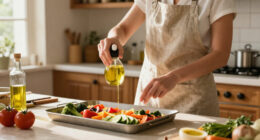
Her suggested method is straightforward: roast vegetables as usual, then add the vinegar as soon as they come out of the oven. Briskin names carrots, squash, Brussels sprouts and potatoes as examples. She says the finishing splash adds acidity and “just the right amount of sweetness,” but the source does not give a measured quantity, cooking temperature or a full recipe.
The review also describes other uses for the vinegar. Briskin says she keeps it for winter slaws and bitter green salads, where she finds it cuts through olive oil and helps soften fibrous greens. She also uses it to finish creamy or meaty soups and stews. The article identifies the product as Colavita white balsamic; it does not report laboratory testing or a blind tasting against other brands.
A Finishing Splash Changes the Balance
The suggestion offers home cooks a low-effort way to adjust a familiar side dish after roasting. Vegetables cooked with oil, salt and pepper can taste rich or sweet; a small amount of vinegar adds acidity, which may make those flavors seem more balanced. Briskin’s recommendation is to use it as a finishing ingredient, rather than describing it as part of the roasting process.
That distinction matters for readers trying the technique: the source gives no universal measurement, and the right amount can depend on the vegetables and portion size. Adding a little and tasting before adding more is a practical approach, not a quantity specified by the report. The product review may also carry a commercial connection: The Kitchn says it independently selects products but may earn a commission if readers buy through its links.
Products Worth Considering

KitchenAid 8-Cup Grain and Rice Cooker with Integrated Scale, Porcelain White

KitchenAid 5.5-Qt Bowl-Lift Stand Mixer, Porcelain White (KSM55SXXX)

Le Creuset Enameled Cast Iron Round Wide Dutch Oven, 3.5 qt, Sea Salt
As an affiliate, we earn on qualifying purchases.
How White Balsamic Differs
The article’s case for white balsamic rests on its flavor and texture. Briskin characterizes it as less syrupy than traditional balsamic and less sharply acidic than white or red wine vinegar. Those descriptions are the writer’s assessment of the product and ingredient, not a formal classification or a finding from a published taste test.
Briskin places the suggestion within her own routine of roasting root vegetables, squash and Brussels sprouts, particularly during winter. The source does not identify a new product launch or a broader change in cooking practice. The development is the publication of a product recommendation showing one way the writer uses the vinegar at home.
““a splash of the vinegar as soon as they come out of the oven livens things up and adds just the right amount of sweetness.””
— Lizzy Briskin, The Kitchn
No Tested Amount or Comparison
The source does not specify how much vinegar to use, whether to drizzle it over the full tray or individual servings, or whether it works better with particular seasonings. It also provides no controlled taste test, reader survey or comparison with other brands to establish that Colavita performs better than alternatives. Briskin’s account is a personal recommendation.
The supplied material does not include the product’s price, bottle size, ingredient label or a precise publication date; it only says the piece was published “yesterday.” Readers should check the product packaging for ingredient and allergen information, since the report does not provide a complete label. No independent confirmation of the review’s sensory descriptions is included.
Readers Can Test the Finish
The article invites readers to share their favorite uses for white balsamic in the comments, but the supplied material gives no information about responses or any planned follow-up. For cooks interested in the technique, the immediate next step is to try a modest splash on hot roasted vegetables and adjust to taste. No further testing or product update is announced in the source.
Key Questions
When should white balsamic go on roasted vegetables?
Briskin recommends adding it as soon as the vegetables come out of the oven, as a finishing touch. The source does not test adding it before roasting.
Which vegetables does the article mention?
Briskin names carrots, squash, Brussels sprouts and potatoes. She does not claim the method is limited to those vegetables.
How much vinegar should I use?
The article gives no measured amount. Start with a small splash, taste, and add more if wanted; that is practical guidance, not a quantity tested or prescribed in the review.
Is the review a comparison showing Colavita is the best brand?
No. The source presents Briskin’s personal recommendation for Colavita white balsamic, but does not report a blind tasting or comparison with other brands.
Source: thekitchn.com