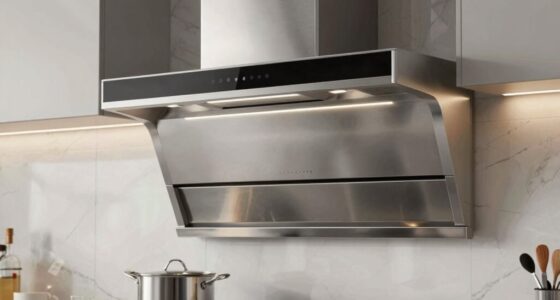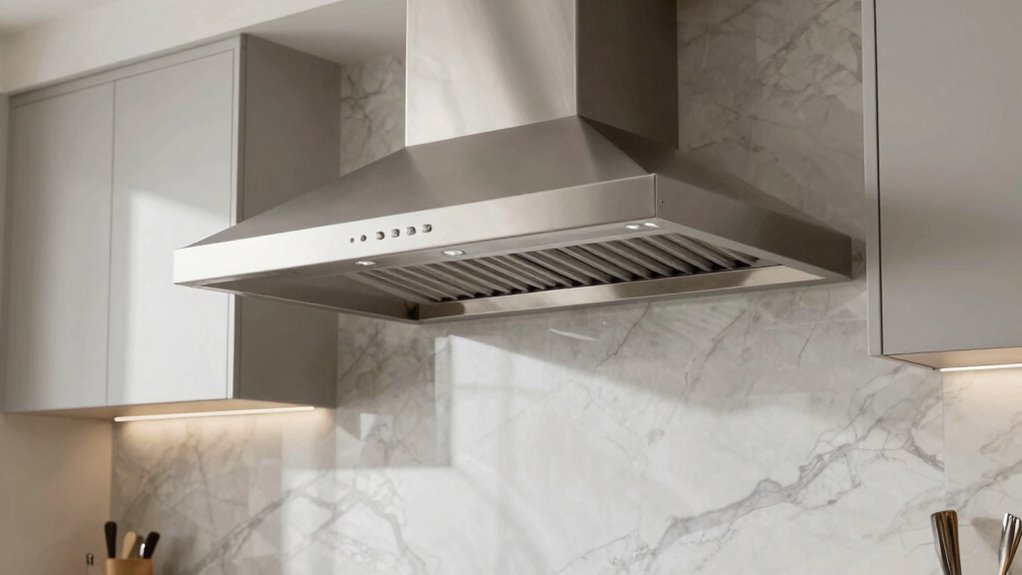

To choose the right size for your range hood, consider your cooktop’s size and cooking habits. Most homes need a capacity of 300 to 600 CFM, but if you cook often or use high-powered burners, opt for higher capacity. Confirm the hood’s footprint matches your space and complements your kitchen style, whether modern or vintage. Proper sizing and placement improve both performance and look—keep exploring to learn more about creating the perfect fit for your kitchen.

Get kitchen staples and gadgets delivered free — and shop member deals
- Fast, free delivery on millions of items
- Access to Prime Big Deal Days deals on October 6–7
- Prime Video, Amazon Music and more included
Key Takeaways
- Match the hood’s CFM rating to your stove’s size and cooking frequency for effective ventilation.
- Measure your cooktop’s width to select a hood with an appropriate footprint that offers adequate coverage.
- Higher CFM hoods are needed for high-powered burners or frequent cooking to ensure proper odor and smoke removal.
- Consider noise levels associated with different CFM capacities to balance performance and comfort.
- Ensure proper installation and adherence to ventilation standards for optimal safety and efficiency.
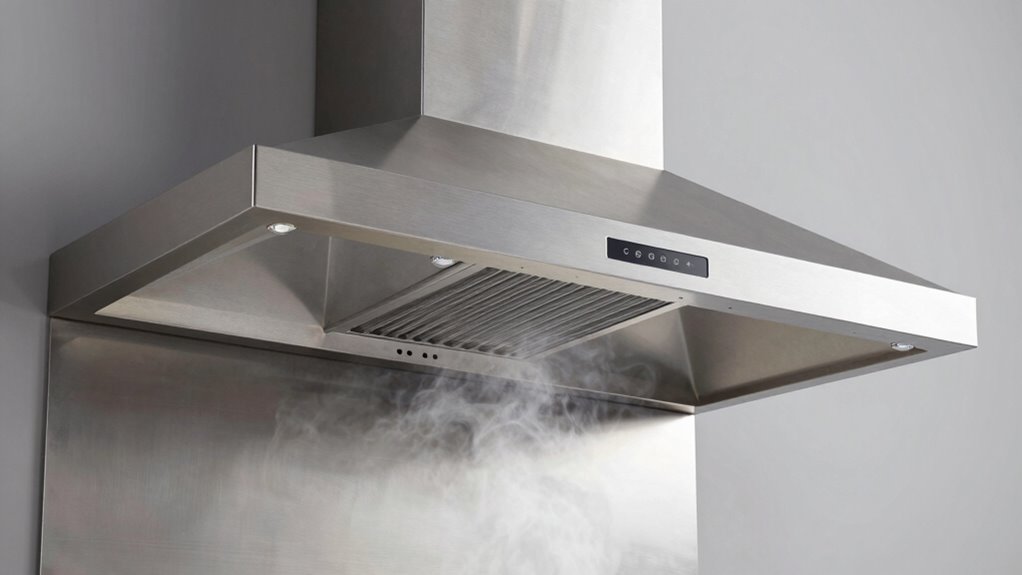
Range hoods come in a variety of styles, from sleek modern designs to traditional or custom-built options. Your choice should complement your kitchen’s overall decor. For example, if you have a contemporary space, a stainless steel or glass hood can add a clean, polished look. On the other hand, a wooden or ornate hood might suit a more classic or vintage kitchen. Consider how the hood’s design integrates with your cabinets and backsplash, aiming for a cohesive appearance. Some hoods are designed to be visible statement pieces, while others are meant to blend seamlessly into the cabinetry. Proper sizing and placement are crucial for optimal performance and aesthetics. Capacity is another critical factor. The size of your range hood influences its ability to ventilate effectively. Hoods are rated in cubic feet per minute (CFM), indicating how much air they move per minute. For most home kitchens, a hood with a capacity of 300 to 600 CFM suffices, but if you’re cooking frequently or using high-powered burners, you might need something higher. Remember, the greater the capacity, the more powerful the ventilation, but also consider noise levels. A high-CFM hood can be louder, so look for models with adjustable fan speeds to balance performance with comfort. In real-world use, choosing a range hood that matches your cooking habits and space constraints ensures you keep your kitchen clean and odor-free. Additionally, proper installation not only enhances safety but also ensures the hood operates at peak efficiency. It’s also beneficial to understand ventilation standards to ensure your setup complies with safety regulations and optimizes airflow. Being aware of these standards can also help you select the most suitable venting options for your specific kitchen layout. Prioritize installation considerations and aesthetic options to find a hood that’s both functional and attractive. Proper sizing and placement make all the difference in achieving excellent ventilation without sacrificing style.
As an affiliate, we earn on qualifying purchases.
Frequently Asked Questions
How Do I Measure My Kitchen Space for a Range Hood?
To measure your kitchen space for a range hood, start by checking the cabinet clearance above your stove—ideally, the hood should be 24-30 inches above the cooktop. Next, consider duct routing to guarantee proper venting without obstructions. Measure the width of your cooktop to match the hood’s footprint, and account for space needed for duct connections. Accurate measurements help you choose a range hood that fits perfectly and works efficiently.
What Is the Ideal Noise Level for a Range Hood?
You’ll want a range hood with noise levels around 60 decibels—roughly as loud as a normal conversation. Studies show that noise can be a major annoyance, with loud hoods reaching 70 decibels or more. Using sound measurement, select a hood that operates quietly to avoid disrupting your cooking or conversations. Ideally, aim for a model that balances effective ventilation with minimal noise, so your kitchen remains a comfortable space.
Can a Larger Range Hood Fit in a Small Kitchen?
A larger range hood can fit in a small kitchen if you choose one with a slim profile that matches your cooking style and aesthetic. You might need to adjust cabinetry or wall space, but a well-chosen, sleek design can enhance your kitchen’s look. Make certain the hood’s capacity matches your cooking needs, so it functions efficiently without overwhelming the space or compromising your kitchen’s visual harmony.
How Often Should I Clean My Range Hood Filter?
Imagine the chaos of smoky kitchen fumes overwhelming your space—yikes! To prevent that, you should clean your range hood filter every 1 to 3 months, depending on how often you cook. Regular filter maintenance keeps your air fresh and your hood working efficiently. Following a consistent cleaning schedule guarantees grease and grime don’t build up, so your kitchen stays safe, clean, and inviting.
Are There Energy-Efficient Options for Range Hoods?
Yes, you can find energy-efficient range hoods with favorable energy labels like ENERGY STAR. These models often feature eco-friendly components, such as LED lighting and high-efficiency motors, which reduce power consumption. Choosing an energy-efficient range hood not only lowers your electricity bills but also minimizes environmental impact. Look for models that highlight their eco-friendly features and energy ratings to guarantee you’re making a sustainable, cost-effective choice.
stainless steel kitchen range hood
As an affiliate, we earn on qualifying purchases.
As an affiliate, we earn on qualifying purchases.
Conclusion
By now, you understand how vital proper range hood sizing is for safety and efficiency. Choosing the right capacity and footprint ensures your kitchen stays fresh and smoke-free. Don’t settle for guesswork—measure, compare, and select wisely. After all, isn’t a well-functioning range hood worth the investment? With these tips, you’ll be confident in your decision and enjoy a cleaner, more comfortable cooking space every day.
custom built range hood for vintage kitchen
As an affiliate, we earn on qualifying purchases.
As an affiliate, we earn on qualifying purchases.
As an affiliate, we earn on qualifying purchases.
Evergreen bestsellers Picks
bestsellers
As an affiliate, we earn on qualifying purchases.