
🔍 Read the full analysis: Bistecca Alla Fiorentina: Sourcing, Searing, And Slicing The Great Steak on Mad Tasting

Get kitchen staples and gadgets delivered free with Prime
- Fast, free delivery on millions of items
- Prime Video, Amazon Music and more included
- Member-only deals all year
TL;DR
Mad Tasting’s guide describes bistecca alla Fiorentina as a thick, bone-in T-bone associated with Florence and Tuscany, traditionally seared over intense heat and served rare. It advises home cooks to ask a butcher about the cut, breed and aging, use a thermometer rather than fixed cooking times, and carve the steak across the grain for sharing. The guide also notes that the traditional rare preparation may not meet standard food-safety advice for whole cuts of beef.
Mad Tasting’s guide to bistecca alla Fiorentina explains how to choose, cook and carve the thick T-bone steak associated with Florence and Tuscany, while flagging the gap between its traditional rare serving style and general food-safety advice. The guide recommends asking a butcher about the cut, breed, origin and aging, then using a thermometer to judge doneness rather than relying on a fixed cooking time.
Mad Tasting describes the steak as typically cut at least 3–4 centimeters thick and including both the tenderloin and strip loin, separated by a T-shaped bone. The guide says it is generally presented whole and shared, rather than served as a small individual steak. It explains that the thickness gives cooks more time to brown the surface before the center cooks through. The guide also suggests looking for a clear bone and visible portions of both loin muscles; some marbling on the strip side can contribute flavor.
Chianina cattle, a large white breed native to central Italy, are closely associated with the dish, but Mad Tasting notes that the name bistecca alla Fiorentina does not itself guarantee a particular breed or place of origin. The guide advises asking the butcher where the animal was raised, what breed it was, how long the beef was aged and whether the steak comes from the loin. It treats aging as a matter of flavor and texture, not a requirement: dry-aged beef may have concentrated flavor, while fresh or wet-aged beef can also be used.
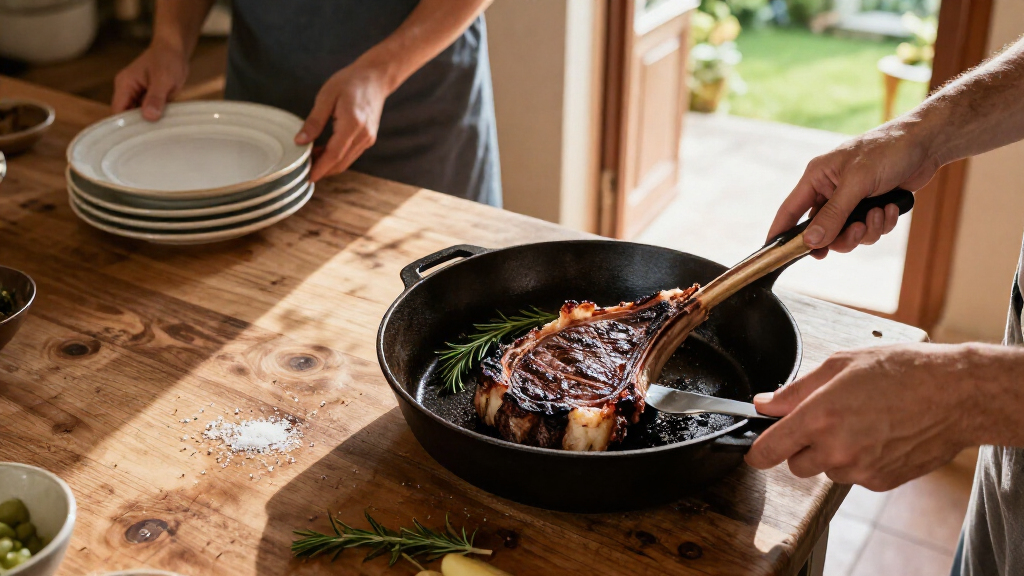
For cooking, Mad Tasting recommends drying and salting the meat, then searing it over very high heat using charcoal, a gas grill or a heavy pan. If the outside browns before the center reaches the cook’s preferred doneness, the guide says the steak can be moved to a cooler grill zone or finished over lower heat. Because timing varies with thickness, equipment and heat, it recommends an instant-read thermometer. After a brief rest, carve the meat away from the bone and slice both sides across the grain for serving.
Mad Tasting · Field Guide · Florence & Tuscany
Bistecca alla Fiorentina: Sourcing, Searing, and Slicing the Great Steak
A practical guide to choosing the cut, building a deep sear, and carving a steak made for the table. Its celebrated rare style comes with a food-safety tradeoff worth understanding.
01 / Know the cut
A Florentine steak built for sharing
Associated with Florence and Tuscany, bistecca alla Fiorentina is typically served whole. Its bone and generous scale make it a centerpiece rather than a small individual steak.
Cut profile
Thick, bone-in T-bone
Look for a clear T-shaped bone and visible portions of both loin muscles. The guide recommends a thickness of at least 3–4 centimeters.
Regional association
Tuscany, with nuance
The dish has strong ties to Florence and local dining customs. Stories about its name and origins vary, so treat them as tradition rather than settled history.
Breed and origin
Ask; don’t assume
Chianina cattle are closely associated with the dish, but “Fiorentina” alone does not confirm a breed, farm, or place of origin.
Tenderloin
Usually the smaller, more tender side of the bone.
Strip loin
Often firmer in bite, with visible marbling that can contribute flavor.
02 / Buy with clarity
What the label can—and can’t—tell you
A dish name is a style cue, not proof of provenance. A short conversation with the butcher or restaurant can clarify what is actually known about the beef.
Ask the seller
Get the specifics
Confirm the loin cut and both muscles. Ask about breed, where the animal was raised, and what the seller can verify about origin.
Aging
Flavor, not a rule
Dry aging can concentrate flavor. Fresh or wet-aged beef can also work; aging is a preference for flavor and texture, not a requirement.
Plan the setup
Prepare for two heat zones
Use charcoal, a gas grill, or a heavy pan for a strong initial sear. Have a cooler grill zone or lower heat ready for finishing.
03 / From grill to platter
Cook by the steak, not the clock
Thickness, starting temperature, equipment, and heat all change timing. A thermometer gives you a useful reading; a fixed number of minutes cannot account for every steak.
Prepare
Dry & salt
Dry the surface and season the meat before cooking.
Sear
Start very hot
Use charcoal, gas, or a heavy pan to brown the exterior.
Finish
Check the center
Use an instant-read thermometer; move to gentler heat if needed.
Serve
Rest & carve
Briefly rest, remove meat from the bone, and slice across the grain.
04 / Questions at the counter
A quick checklist before cooking
Use these prompts to choose a steak that suits your meal, equipment, and comfort with doneness.
Is it the right cut?
Ask for a thick T-bone from the loin, with both tenderloin and strip loin attached.
What can you confirm?
Ask about breed, raising region, and aging. The name “Fiorentina” guarantees none of these details.
How will you manage heat?
Make sure your grill or pan can sear hard, with a cooler zone or lower heat available to finish.
How will you judge doneness?
Have an instant-read thermometer ready. Choose with food-safety advice in mind; cooking time varies.
05 / At the table
Carving is part of the format
Both sides of the bone bring their own texture. A few deliberate cuts turn one dramatic steak into easy-to-serve portions for the group.
First
Separate from the bone
Carve the meat away from the T-bone after a brief rest.
Then
Slice across the grain
Cut both loin sections across their visible muscle fibers for easier serving.
Finally
Serve the contrast
Offer tenderloin and strip loin together so guests can enjoy their different textures.
Choosing Doneness and Serving Safely
Mad Tasting’s guide is relevant to home cooks because this is a large, expensive cut where small choices affect both the result and the number of people it can serve. The guide advises asking about breed, provenance and aging to distinguish what a seller can verify from what the dish’s name may suggest. It also explains that choosing a thick steak makes it easier to create a browned exterior without overcooking the middle.
There is a practical food-safety tradeoff. Bistecca alla Fiorentina is known for being served very rare, but the guide’s recommendation to use a thermometer does not make rare beef automatically safe for everyone. Standard food-safety guidance generally calls for whole cuts of beef to reach 63°C (145°F), followed by a three-minute rest. People at higher risk from foodborne illness, including pregnant people, young children, older adults and those with weakened immune systems, should follow public-health advice and avoid undercooked meat. Keep raw beef refrigerated until shortly before cooking, use clean utensils and surfaces, and do not let it sit at room temperature for an extended period.
Mad Tasting presents carving as part of the dish’s shared format, not just presentation. Removing the meat from the bone and slicing across the grain makes the portions easier to serve, while the two loin sections offer different textures. The guide’s approach gives readers a way to adapt a regional preparation at home without presenting a particular level of rarity as necessary.
Products Worth Considering

Le Creuset Enamemed Cast Iron Oval Dutch Oven, 5 qt., White/Crucible

Le Creuset Signature 6.5-Quart Deep Round Dutch Oven with Light Gold Crucible Knob, Enameled Cast Iron, Bleu Riviera

Le Creuset Enameled Cast Iron Round Bread Oven, 9.5-Inch, Cerise
As an affiliate, we earn on qualifying purchases.
A Florentine Cut With Regional Ties
Mad Tasting describes bistecca alla Fiorentina as associated with Florence and Tuscany, where a substantial bone-in steak is commonly ordered by weight and shared at the table. The guide explains that the T-bone joins two familiar cuts: the tenderloin, usually the smaller and more tender side, and the strip loin, which tends to have a firmer bite and more visible marbling. Its scale and bone make the steak suited to presentation on a platter and carving for a group.
According to Mad Tasting, stories about the dish’s name and origins connect it to Florentine celebrations and restaurant customs, but these accounts vary. The guide treats them as local tradition rather than settled history. It describes the lasting format as beef with the bone in, intense heat and restrained seasoning. For someone ordering in Florence, asking about weight, origin and breed can clarify what is actually being served; for a home cook, the same questions help separate a recognizable style from a guaranteed regional source.
What the Steak Label Cannot Confirm
The Mad Tasting source material does not give a publication date, identify a specific restaurant or butcher, or cite an official certification for the steak’s origin. The guide cautions that “Fiorentina” does not establish breed or provenance, and says restaurants may serve beef from different breeds and regions. Buyers need to ask sellers for details rather than infer them from the dish’s name.
Mad Tasting does not provide a universal cooking time, and exact timing and final temperatures will vary with steak thickness, starting temperature, grill or pan, and heat intensity. The guide’s traditional rare style also differs from standard food-safety recommendations for whole cuts of beef, leaving diners to weigh culinary preference against public-health advice.
Questions to Ask Before Cooking
Mad Tasting’s guide advises home cooks to speak with a butcher before buying: confirm that the steak is a thick T-bone with both loin portions, then ask about breed, raising region and aging. Check that the cooking equipment can produce a strong initial sear and, if needed, a cooler area for finishing. Have an instant-read thermometer ready, and decide on a doneness level with food-safety guidance in mind.
At the table, the guide recommends resting the steak briefly, carving the meat off the bone and slicing across the grain. Mad Tasting’s source material does not announce a new product, restaurant opening or upcoming event; it presents practical guidance for readers planning to order the dish in Tuscany or prepare a Florentine-style steak at home.
Key Questions
What cut is used for bistecca alla Fiorentina?
Mad Tasting describes it as a thick, bone-in T-bone steak containing both tenderloin and strip loin. The guide recommends a thickness of at least 3–4 centimeters.
Does bistecca alla Fiorentina have to come from Chianina cattle?
No. Mad Tasting notes that Chianina cattle are strongly associated with the dish, but the name does not guarantee a particular breed or origin. Ask the butcher or restaurant what they can confirm about the beef.
How should I cook a thick Florentine-style steak?
Mad Tasting recommends drying and salting the steak, searing it over high heat, and moving it to gentler heat if the crust forms before the center reaches your chosen doneness. Use an instant-read thermometer because cooking time varies with the steak and equipment.
Is rare steak safe to eat?
Rare beef is not risk-free. Standard food-safety advice for whole cuts of beef is to cook them to 63°C (145°F) and rest for three minutes. People at higher risk from foodborne illness should follow public-health guidance and avoid undercooked meat.
How is the steak served?
Mad Tasting says it is commonly brought to the table whole for sharing. Carve the meat away from the bone and slice both loin sections across the grain into portions.
Source: Mad Tasting