TL;DR

Get kitchen staples and gadgets delivered free with Prime
- Fast, free delivery on millions of items
- Prime Video, Amazon Music and more included
- Member-only deals all year
A post by Casual Physics Enjoyer describes a home experiment in which thin chicken breast soaked in tartrazine, a yellow food dye, became partly translucent. The result was weaker than the effect reported in a scientific paper, and the chicken was discarded rather than eaten.
A home experiment reported by Casual Physics Enjoyer found that thin pieces of raw chicken breast became partly translucent after soaking in a solution of tartrazine, a yellow-orange food dye used in some snacks. The result was limited: the author said it fell short of the transparency described in a research paper and emphasized that the chicken was not safe to eat.
The author said the experiment followed a suggestion from friend Adaobi Adibe and was intended as a preliminary attempt to reproduce part of a published method for making biological tissue optically transparent. In the home test, chicken was soaked at room temperature in a solution estimated at about 0.19 molar tartrazine. A sample soaked for six hours showed grid lines beneath it when illuminated, while a water-soaked control remained opaque. The writer described the treated tissue as having a gummy, gelatin-like appearance.
A later trial used covered test tubes and a 12-hour soak at room temperature. The author reported slight visible translucency compared with the control, particularly in thin slices viewed under a light. The post does not report instrument-based measurements, repeated trials, or a quantitative assessment of how much light passed through the tissue. The result is therefore a visual observation from an informal experiment, not evidence that the method reliably makes chicken transparent.
The author also reported that a more concentrated solution, estimated at about 0.56 molar, appeared to crystallize on the chicken and was treated as a failed attempt. The dye powder was listed as more than 80% dye, so the writer cautioned that the actual concentration could be lower than the nominal calculation. The samples were discarded; the post explicitly warns against eating them because raw chicken can carry Salmonella.
A Low-Cost Test of Tissue Imaging
The experiment offers a small, informal demonstration of a method that could matter for imaging biological tissue. The research paper cited by the author describes using absorbing molecules, including tartrazine, to alter optical properties so that tissue becomes more transparent. If such methods can be adapted for simple equipment, they could help people observe structures inside tissue without relying on more specialized imaging setups.
That possibility remains a research motivation, not a result established by this test. The home experiment showed only partial translucency in thin raw chicken under lighting, and it did not demonstrate clear imaging of internal structures. The report also does not establish that a kitchen-grade preparation can reproduce the published effect or that it is suitable for use on living animals. Its value is as an early, low-cost observation that may guide further testing, rather than as a validated protocol.
food dye for scientific experiments
As an affiliate, we earn on qualifying purchases.
As an affiliate, we earn on qualifying purchases.
The Published Method and Home Trial
The post refers to a paper by Ou and colleagues titled “Achieving optical transparency in live animals with absorbing molecules.” According to the writer’s account, the study used tartrazine to make biological tissues, including chicken breast, more transparent. The reported paper protocol used a 0.62 molar solution, a temperature of 40°C, and a machine shaker.
The writer did not reproduce those conditions. They said they lacked suitable equipment and could not find a way to carry out the warmer protocol safely, so they used lower concentrations at room temperature. Tartrazine was mixed with tap water, and the chicken was cut from a roughly 5-millimeter slab. In the six-hour comparison, the middle-strength solution produced the visible change, while the more concentrated mixture crusted and the water control stayed opaque.
The post proposes a possible explanation: tartrazine’s absorption properties may change the refractive index of water, bringing it closer to that of proteins and fats in tissue and reducing light scattering. The author presents this as a working model and says a fuller explanation may follow. The supplied report does not independently test that mechanism.
“I got partial transparency but not to the degree of the paper.”
— Casual Physics Enjoyer
As an affiliate, we earn on qualifying purchases.
Limits of the Visible Result
The report does not provide a controlled measurement of transparency, independent replication, or enough detail to determine how consistently the effect would occur. It is also unclear how much of the visual change came from tartrazine itself versus sample thickness, lighting, or other preparation differences. The powder’s stated dye content was above 80%, adding uncertainty to the estimated solution concentrations.
The mechanism remains a hypothesis in the post, and the home test does not establish whether the same approach would work in other tissues or under safe, controlled conditions. No evidence is provided that the method was tested on living animals by the author. The report describes raw chicken left at room temperature for extended periods, so the samples were not food-safe; the author says they were thrown away.
food coloring for food science projects
As an affiliate, we earn on qualifying purchases.
As an affiliate, we earn on qualifying purchases.
Further Tests Are Still Pending
The author said a more ambitious replication was planned, but the post gives no date, detailed protocol, or results for that work. Any follow-up would need to clarify the dye concentration, temperature, exposure time, and handling conditions, while measuring light transmission rather than relying only on photographs or visual inspection.
The writer also said they intended to explain the proposed optical mechanism in more detail. Until additional results are published, the finding remains a preliminary observation: tartrazine-treated chicken appeared somewhat translucent in a home setup, but the reported effect was modest and the method has not been established as a dependable imaging procedure.
As an affiliate, we earn on qualifying purchases.
Key Questions
Did the experiment make chicken fully transparent?
No. The author reported partial translucency in thin pieces, with grid lines visible underneath in one setup. They said the result did not reach the degree described in the research paper.
What is Dorito dust in this experiment?
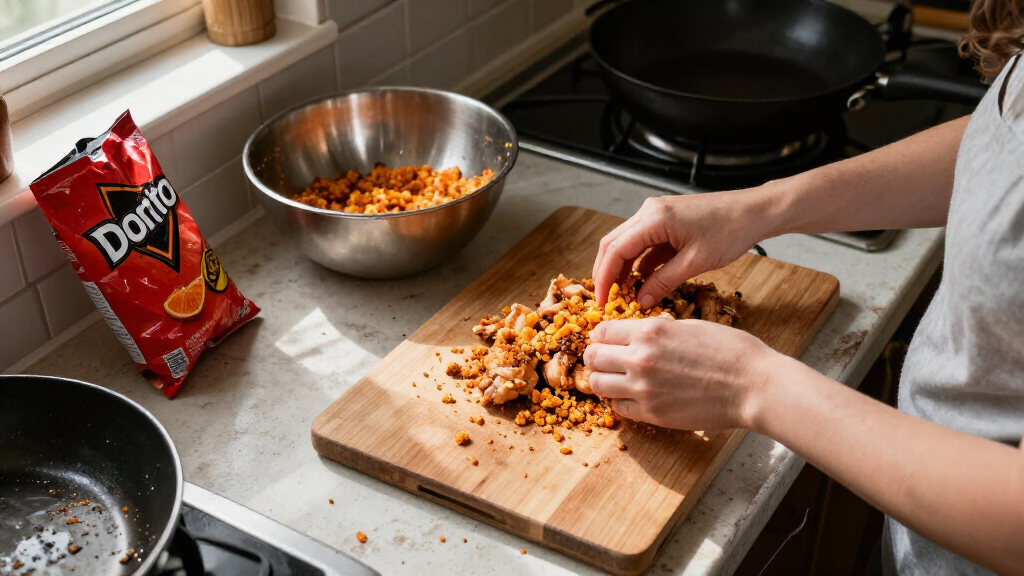
The experiment used tartrazine, a yellow-orange food dye the post says is found in some Doritos. It used dye powder mixed with water, not crushed snack chips.
Why might tartrazine make tissue look more transparent?
The author proposed that tartrazine could shift water’s refractive index closer to that of proteins and fats in tissue, reducing light scattering. The post describes this as a working explanation, not a mechanism confirmed by the home trial.
Is the treated chicken safe to eat?
No. The samples were raw chicken soaked at room temperature, and the author warned that eating them could expose someone to Salmonella. The post says the pieces were discarded.
Has the home experiment been independently confirmed?
The supplied report does not describe independent replication or quantitative measurements. It is an informal account of a preliminary test, so the repeatability and strength of the effect remain unclear.
Source: hn
Halloween Picks
halloween
As an affiliate, we earn on qualifying purchases.