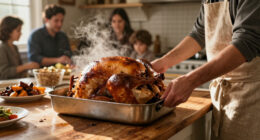
This guide helps home cooks choose and use a Thanksgiving roasting pan for a turkey, vegetables, and pan drippings. You will check the fit, set up the pan, roast the turkey, and verify doneness with a food thermometer. It is written for beginners and takes about 30-60 minutes to choose and prepare the pan; roasting time depends on the turkey’s weight and recipe.

Get kitchen staples and gadgets delivered free with Prime
- Fast, free delivery on millions of items
- Prime Video, Amazon Music and more included
- Member-only deals all year

EWFEN 17×13-Inch Stainless Steel Turkey Roaster with V-Shaped and Flat Racks
- ✔ Material: Stainless steel
- ✔ Pan dimensions: 17 × 12.6 × 5.9 inches listed
- ✔ Baking area: 17 × 13 inches stated

17×13-Inch Nonstick Turkey Roasting Pan with U-Shaped Rack
- ✔ Pan size: 17 × 13 inches in title
- ✔ Other listed dimensions: 15 × 8 × 3 inches
- ✔ Stated turkey capacity: Up to 22 pounds

Glad Nonstick Roasting Pan, 11×15 Inches, with Rack
- ✔ Pan dimensions: 15 × 10.3 × 2.8 inches, excluding handles
- ✔ Material: Heavy-duty carbon steel
- ✔ Finish: Nonstick; PFOA-free and PTFE-free stated
Difficulty: Beginner | Time: 30-60 minutes to select and prepare the pan, plus the turkey’s roasting time
What You’ll Need
Tools & Materials:
- Roasting pan large enough for the turkey, with sturdy handles
- Roasting rack, if the pan does not include one
- Instant-read or leave-in food thermometer
- Oven mitts
- Carving board and platter
Knowledge:
- Basic oven use
- How to read a food thermometer
- How to lift a hot pan safely, preferably with another adult
Check the pan maker’s temperature and stovetop-use guidance before cooking. A disposable foil pan may need a rimmed baking sheet underneath for support. Thaw the turkey completely in the refrigerator before roasting; allow roughly 24 hours for every 4-5 pounds, with extra time for a larger bird.
EWFEN 17×13-Inch Stainless Steel Turkey Roaster with V-Shaped and Flat Racks
For a Thanksgiving kitchen that wants one pan to handle the turkey and other dishes, the EWFEN stainless steel roaster has the most adaptable setup in this group. Its 17-by-13-inch baking area and 3.5-inch-deep rim are intended to contain juices and sauces, while the included V-shaped rack supports a bird and the separate flat rack broadens the set’s use for other roasting jobs. Compared with the single-rack nonstick options, that second configuration gives us more room to adapt the pan to the menu.The stainless steel body is the key distinction: it avoids a nonstick coating and is described as heavy-duty and warp-resistant. The fixed handles offer a secure grip, but a full pan with a large bird and drippings will still call for a careful two-handed lift. The listing’s “non-stick coating” wording conflicts with its description of polished stainless steel and rust resistance, so we would confirm the finish if that detail matters to us. At nearly six inches tall by the listed overall dimensions, this pan also needs a generous oven and storage space. It is the strongest all-around fit here for cooks who value rack flexibility and material durability over a compact footprint.
Pros:
- Includes V-shaped and flat racks for different roasting tasks
- 17-by-13-inch area and 3.5-inch depth suit large roasts and saucier dishes
- Stainless steel construction avoids depending on a nonstick coating
- Fixed handles provide dedicated grip points
Cons:
- Large listed dimensions may be awkward in compact ovens and cabinets
- Finish description is inconsistent about whether the pan has a nonstick coating
- A full pan may be cumbersome to lift safely
Best for: Thanksgiving hosts who want a large stainless steel roaster with two rack options for poultry and other dishes.
Not ideal for: Cooks with a small oven or limited storage, or anyone who specifically wants a clearly documented nonstick surface.
Bottom line: Choose the EWFEN when we want the most versatile Thanksgiving set and have room for a large, deep pan.
“Choose the EWFEN when we want the most versatile Thanksgiving set and have room for a large, deep pan.”
17×13-Inch Nonstick Turkey Roasting Pan with U-Shaped Rack
When the centerpiece is a substantial turkey, this 17-by-13-inch roaster makes its case with a stated capacity of up to 22 pounds and a U-shaped rack that lifts the bird above collected fat and juices. Its raised handles are meant to make the rack easier to remove, while the pan’s angled external handles preserve more of the cooking area than handles positioned inside the pan. Those details make it a more focused turkey pan than the Glad, whose smaller dimensions suit more modest roasts.The nonstick surface is presented as free of PTFE, PFOA, cadmium, and lead, which may simplify releasing browned food and cleaning after dinner. The product description refers to both aluminized steel and carbon steel, however, so the exact base material is not clear from the supplied information. Its stated 450°F maximum is also lower than Glad’s listed 464°F limit. Although the listing calls the pan deep, its measurement block gives 15 × 8 × 3 inches, which does not neatly match the 17 × 13-inch product name. We should measure our oven and confirm the actual exterior size before choosing it. It suits cooks prioritizing a large turkey capacity and easy-release coating; the EWFEN remains a better fit when rack choice and stainless construction matter more.
Pros:
- Stated capacity accommodates a turkey up to 22 pounds
- U-shaped rack raises the bird above drippings and has lifting handles
- Angled external handles preserve interior cooking space
- Nonstick coating is described as free from PTFE, PFOA, cadmium, and lead
Cons:
- Listed dimensions conflict with the 17-by-13-inch title
- Material description alternates between aluminized steel and carbon steel
- 450°F stated maximum is lower than Glad’s listed limit
Best for: Hosts roasting a turkey up to the stated 22-pound capacity who prefer a nonstick pan and lift-friendly rack.
Not ideal for: Buyers who need unambiguous dimensions or material specifications, or who want a pan rated above 450°F.
Bottom line: Pick this roaster for a large holiday turkey if its actual dimensions and material suit our oven and preferences.
“Pick this roaster for a large holiday turkey if its actual dimensions and material suit our oven and preferences.”
Glad Nonstick Roasting Pan, 11×15 Inches, with Rack
The Glad roasting pan is the most approachable choice when a full-size turkey roaster would take up too much oven or cupboard space. Its stated pan dimensions are 15 × 10.3 × 2.8 inches, excluding handles, making it smaller and shallower than the EWFEN. That footprint can work well for chicken, vegetables, or a smaller roast alongside other Thanksgiving dishes, but it gives us less room for a large bird and less depth to contain juices.A V-shaped iron rack lifts food for airflow, and the nonstick coating is described as dishwasher safe. Those conveniences are balanced by stricter use guidance: the listing says not to use the pan under a broiler, on a stovetop, over an open flame, or with abrasive cleaners and metal utensils. In particular, the no-stovetop instruction limits making gravy directly in the roasting pan. Its 464°F oven limit is the highest stated among these three, but it does not overcome those restrictions. Compared with the larger nonstick turkey pan, Glad sacrifices capacity for a more manageable size; compared with EWFEN, it offers simpler cleanup at the cost of stainless steel and a second rack.
Pros:
- Smaller stated footprint is easier to accommodate than the 17-by-13-inch pans
- V-shaped rack supports airflow around the roast
- Nonstick surface is described as dishwasher safe
- Listed oven maximum is 464°F
Cons:
- Shallower and smaller than the other pans, limiting large-turkey capacity
- Not suitable for broiler, stovetop, or open-flame use
- Care instructions prohibit abrasive cleaners and metal utensils
Best for: Cooks with limited oven or storage space who mostly roast chicken, vegetables, or a smaller holiday centerpiece.
Not ideal for: Hosts cooking a large turkey, or anyone who needs broiler use or wants to make gravy on the stovetop in the pan.
Bottom line: Choose Glad for a smaller Thanksgiving roast and convenient cleanup when its appliance restrictions fit our cooking routine.
“Choose Glad for a smaller Thanksgiving roast and convenient cleanup when its appliance restrictions fit our cooking routine.”
As an Amazon Associate we earn from qualifying purchases.
Before You Start
Read the turkey recipe and pan instructions before heating the oven. Measure the turkey and the oven interior, including the distance from the rack to the door and walls. Leave space around the pan so hot air can circulate and the pan can slide out without catching. Keep raw turkey and its juices away from ready-to-eat foods, and wash hands and surfaces after handling it.
Do not rely on the turkey’s weight alone to prove it is cooked. Plan to check the thickest parts with a food thermometer. The turkey is safe when it reaches 165°F (74°C) in the innermost thigh, the innermost wing, and the thickest part of the breast.
Step-by-Step Instructions
Step 1: Measure the turkey and oven
Measure the turkey at its widest points and compare those dimensions with the pan’s interior. Then check that the loaded pan can sit level on the oven rack, with clearance on every side and enough room to pull it out. Choose a pan with sides deep enough to contain juices but not so tall that they block heat from reaching the bird.
Tip: Include the handles and any rack when checking the fit. A pan that barely fits can be difficult to remove safely.
Check: The pan sits level, has room around it in the oven, and can move through the oven opening without scraping.
Step 2: Choose a sturdy pan and rack
Select a heavy-duty pan with secure handles. A metal pan is useful for browning and may work on the stovetop for gravy if its instructions permit. Use a rack to lift the turkey above the drippings; if you do not have one, arrange thick-cut carrots, celery, and onion beneath the bird as a stable base.
Tip: Thin disposable foil pans can bend under a heavy turkey. Set one on a sturdy rimmed baking sheet before adding the bird, and keep the sheet beneath it during roasting.
Check: The turkey’s weight is supported evenly, and you can grip the pan securely with oven mitts.
Step 3: Set up the oven and pan
Position an oven rack low enough to leave clearance above the turkey. Preheat the oven to the temperature in your recipe. Put the rack in the pan, or arrange the vegetables in a single stable layer. Pat the thawed turkey dry, season it as directed, and place it breast-side up in the pan. Tuck the wing tips if the recipe calls for it.
Tip: Do not add water to the pan unless the recipe directs you to. Extra liquid can reduce browning, and a pan filled too high can spill when moved.
Check: The turkey rests securely, the pan is not crowded with liquid, and the oven is at the recipe’s set temperature.
Step 4: Roast the turkey
Place the pan in the oven and roast according to the recipe’s temperature and estimated time. Keep the oven door closed as much as possible so the temperature stays steady. If the breast browns faster than the rest of the bird, cover it loosely with foil as directed by the recipe. Avoid pouring cold liquid over the turkey unless the recipe specifically instructs you to baste.
Tip: Begin checking temperature before the recipe’s earliest expected finish time. Ovens and turkey shape affect cooking time.
Check: The turkey is browning, the pan remains stable, and no juices are spilling or smoking excessively.
Step 5: Check the temperature in several places
Insert a food thermometer into the thickest part of the breast and the innermost thigh and wing, avoiding bone. Check each reading against 165°F (74°C). If any location is below that temperature, return the turkey to the oven and check again after a short interval.
Tip: Follow the thermometer maker’s instructions for placement and reading time. A pop-up timer alone does not verify that all parts are safe.
Check: The innermost thigh, innermost wing, and thickest breast area each read at least 165°F (74°C).
Step 6: Rest the turkey and handle the drippings
Transfer the turkey to a carving board using sturdy utensils and help if needed. Let it rest for the period given in the recipe before carving. Keep the roasting pan level while moving it. If making gravy, pour drippings carefully into a heat-safe separator or use the pan on the stovetop only if the manufacturer says it is safe for that use.
Tip: The pan and drippings stay hot after roasting. Keep children and pets away from the work area, and do not carry an overloaded pan alone.
Check: The turkey rests without being carved immediately, and the drippings are collected without spills or burns.
Step 7: Clean and store the pan
Let the pan cool until safe to handle, then discard food scraps and soak stuck-on residue in warm water. Wash according to the pan maker’s instructions; avoid abrasive scrubbers on coated surfaces. Dry the pan fully before storing it, and inspect handles and coatings for damage.
Tip: Do not put a hot pan into cold water. A sudden temperature change can warp some pans.
Check: The pan is clean, dry, and free of damage that could affect safe handling next time.
Common Mistakes to Avoid
- Choosing a pan by capacity alone and discovering it does not fit the oven. — Measure both the turkey and oven opening, and check clearance with the handles included.
- Using a flimsy foil pan without support. — Set it on a rimmed baking sheet before adding the turkey and keep the sheet underneath throughout roasting.
- Relying on roasting time or a pop-up indicator instead of checking temperature. — Use a food thermometer in the breast, thigh, and wing, and confirm each reaches 165°F (74°C).
- Overfilling the pan with water or other liquid. — Follow the recipe’s liquid amount; leave enough room to move the pan without splashing.
Troubleshooting
Problem: The roasting pan does not fit through the oven opening.
Solution: Do not force it or tilt a hot, loaded pan. Remove the turkey and choose a smaller pan that supports it securely, or use a compatible oven-safe pan arrangement recommended by the recipe.
Problem: The pan bows or feels unstable when lifted.
Solution: Set it down carefully while it is still cool enough to handle safely. Use a sturdier pan or place a disposable pan on a rimmed baking sheet before continuing.
Problem: The turkey is browned but a thermometer reading is below 165°F (74°C).
Solution: Return it to the oven. Cover browned areas loosely with foil if needed, then recheck the breast, thigh, and wing after additional cooking.
Problem: Drippings smoke during roasting.
Solution: Check the recipe and oven for spilled fat or food residue. If the recipe allows, carefully add a small amount of liquid to the pan; do not pour it onto a hot oven floor. Keep the pan level and use oven mitts.
What Success Looks Like
The pan fits the oven with clearance, supports the turkey without bending, and contains the cooking juices. The turkey reaches at least 165°F (74°C) in the innermost thigh, innermost wing, and thickest breast area, then rests before carving. The pan and drippings are handled without spills or burns.
Next Steps
After the meal, refrigerate leftover turkey and gravy within two hours in shallow containers. Clean and dry the pan before storage, following its care instructions. Before using it for another holiday meal, check the handles, surface, and fit for the next bird.
Frequently Asked Questions
What size roasting pan do I need for a Thanksgiving turkey?
Choose one that holds the turkey without touching the sides and fits level in your oven with room for air circulation. Check the pan’s interior dimensions and the oven opening; turkey weight alone does not confirm a good fit.
Do I need a rack in the roasting pan?
A rack keeps the turkey above the drippings and helps hot air circulate underneath. If you do not have one, use a stable layer of thick-cut vegetables as a base, provided the recipe allows it.
Can I use a disposable foil roasting pan?
Yes, if it is large and sturdy enough for the bird. Place it on a rimmed baking sheet before filling it, and keep the sheet underneath when moving the pan to reduce the chance of bending or spilling.
Can I use the roasting pan to make gravy?
Use the pan on a burner only if the manufacturer says it is stovetop-safe. Otherwise, transfer the drippings to a saucepan. Avoid placing glass or coated pans over direct heat unless their instructions permit it.
How can I tell whether the turkey is done?
Check the innermost thigh, innermost wing, and thickest part of the breast with a food thermometer, avoiding bone. Each location must reach 165°F (74°C) for safety.