Your smoothie separates quickly because the emulsion between fats and liquids isn’t stable. Factors like natural ingredient breakdown, blending style, temperature, and lack of stabilizers cause tiny oil droplets to coalesce and float apart. Over time, external disturbances and improper storage worsen this process. To keep it smooth longer, you need the right stabilizers, proper blending techniques, and careful storage. Continue exploring, and you’ll discover effective ways to stop separation before it starts.

Get kitchen staples and gadgets delivered free — and shop member deals
- Fast, free delivery on millions of items
- Access to Prime Big Deal Days deals on October 6–7
- Prime Video, Amazon Music and more included
Key Takeaways
- Natural ingredients and lack of stabilizers cause oil and water in smoothies to separate quickly.
- Over-blending or poor blending disrupts natural emulsifiers, reducing emulsion stability.
- Temperature fluctuations, especially higher heat, weaken surface tension, speeding up separation.
- External disturbances like shaking or vibration break the emulsion’s delicate balance.
- Adding stabilizers such as xanthan gum or healthy fats can significantly prolong smoothie stability.
As an affiliate, we earn on qualifying purchases.
Why Does My Smoothie Separate So Quickly?
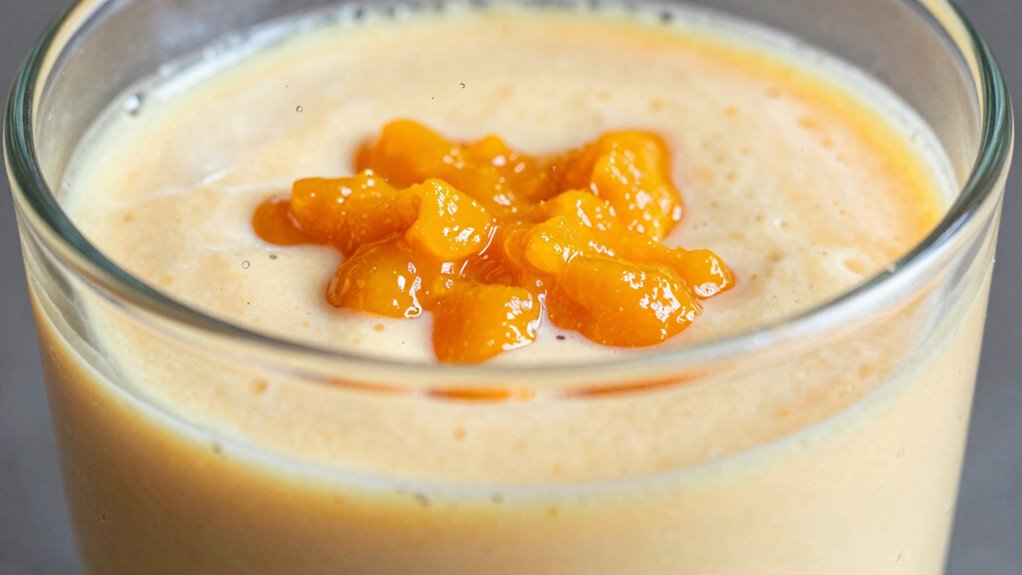
Ever wonder why your smoothie starts to separate just minutes after blending? It all comes down to ingredient stability and blending techniques. When you blend, you’re creating an emulsion, but if the ingredients aren’t stable, they quickly separate. For example, liquids like milk or juice don’t hold onto fats and proteins well, causing separation. Poor blending techniques can also contribute—over-blending can break down natural emulsifiers, while under-blending leaves ingredients unevenly combined. To improve stability, use fresh ingredients and blend thoroughly to break down cell walls and combine components evenly. Incorporating ingredients with natural emulsifiers, like bananas or yogurt, also helps maintain consistency. Mastering blending techniques and selecting stable ingredients can considerably delay separation, keeping your smoothie smooth longer.
As an affiliate, we earn on qualifying purchases.
What Are Emulsions, and Why Do They Matter in Smoothies?
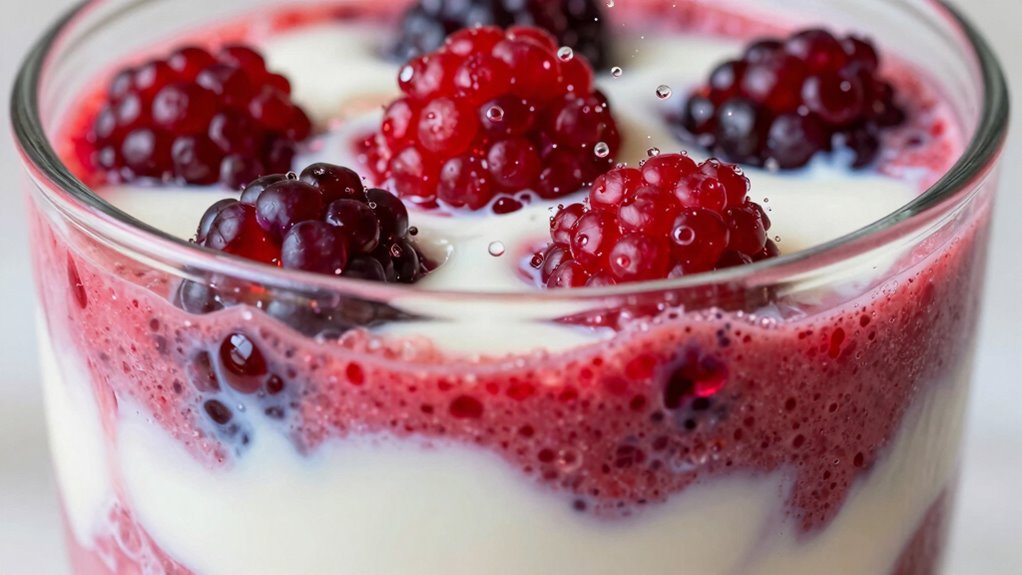
Understanding emulsions is key to making smoother, more stable smoothies. An emulsion is a mixture of two liquids that normally don’t combine, like oil and water. In smoothies, fats from nuts, seeds, or dairy form tiny droplets dispersed throughout the liquid. Emulsion stability depends on droplet size; smaller droplets stay suspended longer, preventing separation. When droplet size is large, the droplets tend to coalesce, causing the mixture to break apart quickly. This is why some smoothies separate within minutes. By controlling droplet size—using proper blending techniques or stabilizers—you can improve emulsion stability. Proper blending techniques help create smaller droplets and a more uniform mixture, which keeps your smoothie smooth and well-blended longer, so you enjoy a creamy texture from the first sip to the last. Additionally, understanding emulsion science allows for better formulation of stabilizers and ingredients to enhance texture and shelf life.
As an affiliate, we earn on qualifying purchases.
How Do Emulsions Break Down Over Time?
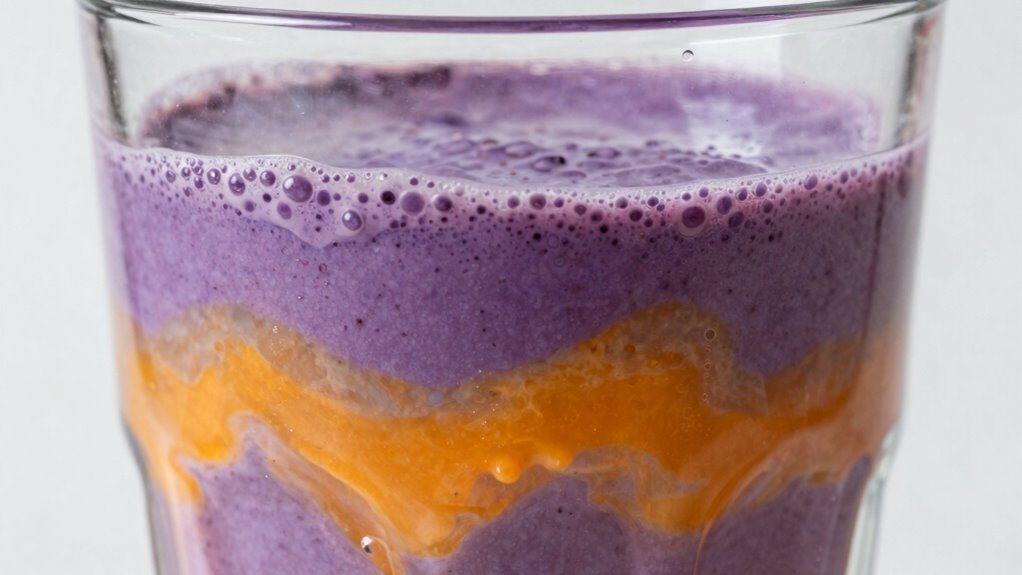
As time passes, the tiny droplets in your smoothie start to merge, a process known as droplet coalescence, which leads to separation. Surface tension plays a key role in keeping these droplets stable, but external disturbances like stirring or jarring can speed up the breakdown. Recognizing these factors helps you understand why your smoothie separates so quickly. Droplet stability can also make your explanations clearer and more direct. Additionally, support breakfast emphasizes that proper emulsion techniques, such as using emulsifiers or stabilizers, can prolong the mixture’s homogeneity, especially relevant for creating consistent smoothies. Incorporating an understanding of water in the wilderness can remind you that controlling external factors, like temperature and agitation, is crucial for maintaining emulsion stability. creative storytelling for branding emphasizes the importance of clear communication in explaining scientific concepts effectively.
Droplet Coalescence Dynamics
Droplet coalescence is the process where tiny oil or fat droplets in your smoothie merge over time, causing the liquid to separate. Larger droplets form as smaller ones combine, speeding up the breakdown. The droplet size directly impacts the coalescence rate—bigger droplets tend to merge faster, leading to quicker separation. Factors influencing this process include temperature, agitation, and the presence of stabilizers. When droplets collide frequently, they’re more likely to coalesce, making the emulsion less stable. As coalescence progresses, the emulsion’s structure weakens, resulting in visible separation. You might notice that smoothies with larger initial droplet sizes break apart quicker, while those with smaller droplets stay mixed longer. Understanding these dynamics helps explain why your smoothie separates so fast. Emulsion stability is also affected by the type of stabilizers used, which can either slow down or accelerate the coalescence process, impacting overall emulsion longevity. Additionally, droplet size can be influenced by mixing techniques and ingredient composition, further affecting the stability. Proper backyard transformation techniques, like using an immersion blender, can help control droplet size during mixing, ultimately improving emulsion stability.
Surface Tension Effects
Surface tension plays a key role in how emulsions like smoothies break down over time. It influences droplet stability by pulling droplets together, encouraging coalescence and separation. When surface tension is high, droplets resist merging, maintaining a stable mix temporarily. Over time, however, energy fluctuations weaken this force, making droplets more prone to coalescence. The table below highlights factors affecting surface tension:
| Factor | Effect on Droplet Stability |
|---|---|
| Temperature | Higher temp lowers surface tension, reducing stability |
| Surfactants | Increase stability by lowering surface tension |
| Age of Emulsion | Aging weakens surface tension, promoting breakdown |
External factors such as agitation or storage conditions can also accelerate separation by disrupting droplet interactions. Understanding these effects helps explain why smoothies separate, as surface tension diminishes, droplet stability declines, and separation occurs. Additionally, emulsion stability can be affected by external factors like agitation or storage conditions, which can accelerate separation. Recognizing how surface tension interacts with these variables aids in controlling and delaying emulsion breakdown, especially through techniques that modify interfacial properties.
External Disturbances Impact
External disturbances such as vibrations, shaking, or sudden movements can accelerate the breakdown of emulsions like smoothies over time. When you move or jostle the container, it disrupts the delicate balance between oil and water droplets, speeding up separation. Changes in air pressure can also affect emulsion stability, especially if the container isn’t airtight. The shape of your container influences how easily disturbances impact the mixture; wider or irregular shapes may cause more turbulence. To minimize breakdown:
- Keep the container steady during storage
- Avoid shaking or moving it unnecessarily
- Use a container with a tight lid to regulate air pressure
- Store in a stable, vibration-free spot
- Choose a shape that limits movement and turbulence
These small actions help maintain emulsion stability longer, preventing rapid separation. Additionally, understanding the emulsion science behind these processes can help you select better storage methods to preserve your smoothies’ texture. Proper storage techniques can also reduce emulsion destabilization caused by external factors.
smoothie storage containers with lid
As an affiliate, we earn on qualifying purchases.
As an affiliate, we earn on qualifying purchases.
What Ingredients and Conditions Help Keep Your Smoothie Stable?
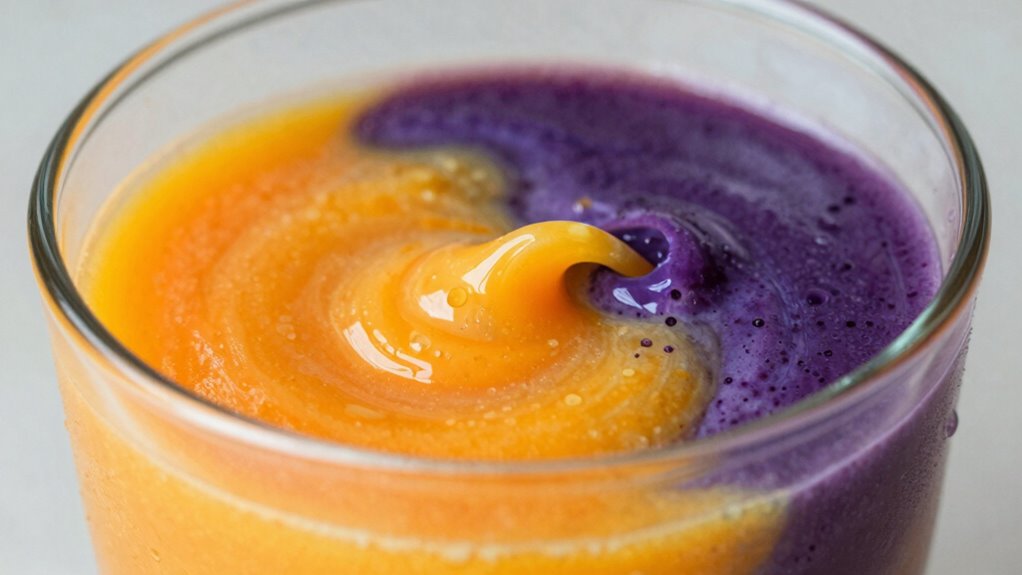
To keep your smoothie from separating quickly, choosing the right ingredients and conditions is essential. Incorporate stabilizer options like fruit pectin, which helps thicken and hold ingredients together, reducing separation. Adding a small amount of fruit pectin can create a more stable emulsion, especially with watery fruits. You can also include other stabilizers such as xanthan gum or guar gum, which prevent liquids from separating over time. Using fresh, ripe ingredients ensures better blending and consistency. Avoid overly aggressive blending, as it can break down natural fibers and destabilize the mixture. Additionally, keeping your smoothie chilled slows down separation. These ingredients and conditions work together to enhance stability and keep your smoothie smooth longer.
How to Make Your Smoothie Stay Smooth for Longer
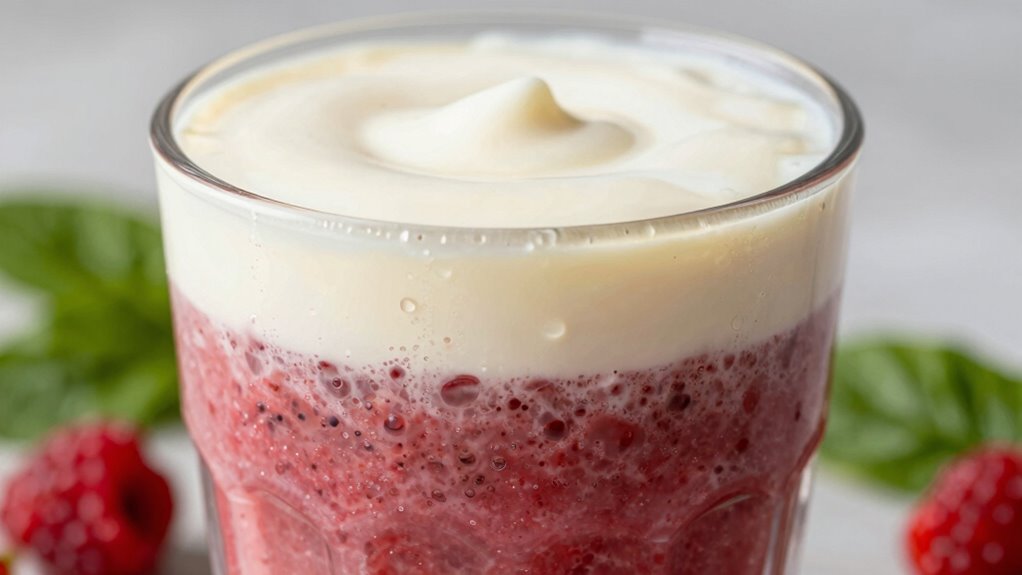
Keeping your smoothie smooth for longer requires more than just the right ingredients; it also depends on how you prepare and store it. To prevent separation, focus on effective flavor pairing and maximizing nutritional benefits. Start by blending ingredients thoroughly to create a stable emulsion. Use ingredients like bananas or avocado, which naturally help suspend other components. Incorporate a splash of healthy fats, such as nut butter or flaxseed, to improve texture and stability. Add a touch of honey or a small amount of yogurt for natural sweetness and better flavor pairing. Emulsion science explains how fats and water-based ingredients can be combined to maintain a uniform texture, which is essential for a smooth smoothie. Understanding the role of emulsifiers can further enhance your ability to create long-lasting emulsions. Additionally, selecting appropriate stabilizers can further improve the consistency and shelf life of your smoothie. Incorporating proper blending techniques can also make a difference in achieving a smooth, uniform mixture. Store your smoothie in an airtight container in the fridge, and give it a quick shake before drinking. These tips keep your smoothie creamy and delicious, maintaining its nutritional benefits and flavor for longer. Incorporating connected equipment like smart blenders can further optimize your blending process for better consistency and freshness.
What Should I Do If My Smoothie Has Already Separated?
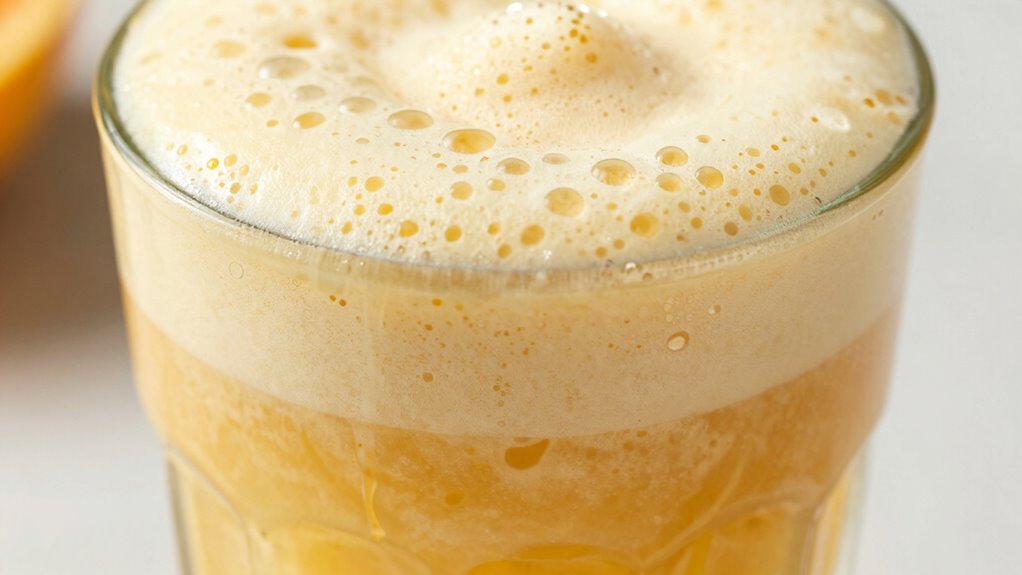
If your smoothie has already separated, don’t worry—there are simple ways to fix it quickly. First, give it a good stir with a spoon or shake it gently in the container to redistribute the fruit pulp and liquid. If that doesn’t work, blend it again for 10 to 15 seconds, increasing the blender speed gradually. This helps re-emulsify the ingredients and restore its creamy texture. Using a higher blender speed creates more shear force, which can re-blend the separated layers effectively. If separation persists, consider adding a small amount of thickening agent like banana or yogurt next time, as they help stabilize the emulsion. Additionally, choosing a blender with strong suction power can prevent separation by thoroughly blending ingredients from the start. With these steps, you’ll have a smooth, well-blended smoothie in no time.
Frequently Asked Questions
Can Adding More Liquid Prevent Smoothie Separation?
Adding more liquid can help prevent your smoothie from separating quickly. When you include the right fruit pairing, it creates a more stable emulsion. Also, blending at a higher blender speed ensures ingredients mix thoroughly, reducing separation. Keep in mind, too much liquid might thin your smoothie too much, so find a balance that keeps it creamy and well-blended without separation.
Does Blending Duration Affect Emulsion Stability?
Your blending duration impacts emulsion stability by either enhancing or breaking it down. Short, steady blending follows emulsion principles, creating a uniform mix, while over-blending breaks the emulsion, causing separation. Use blending techniques that balance thorough mixing with gentle agitation. By controlling blending time, you preserve the emulsion, ensuring your smoothie stays smooth and stable longer. Remember, mastering blending techniques and understanding emulsion principles keeps your smoothies perfectly blended.
Are There Specific Ingredients That Naturally Emulsify?
Certain ingredients act as natural emulsifiers by promoting ingredient interactions that stabilize your smoothie. For example, egg yolks contain lecithin, which helps combine water and oils. Bananas and avocados also contain natural fats that support emulsification. Adding honey or mustard can further enhance stability, as they contain natural emulsifiers that encourage better ingredient interactions, preventing separation and maintaining a smooth, consistent texture.
How Does Temperature Influence Emulsion Breakdown?
Imagine a delicate dance where temperature fluctuation gently nudges your smoothie’s ingredients apart. Warmer temperatures weaken emulsifiers, causing phase separation, while cooler ones help keep everything blended. When the temperature rises, the emulsion’s bond loosens, leading to quicker separation. By maintaining consistent, moderate temperatures, you help prevent emulsion breakdown, ensuring your smoothie stays smooth and well-mixed longer.
Can Commercial Stabilizers Prolong Smoothie Freshness?
Yes, commercial stabilizers can prolong your smoothie’s shelf life by preventing separation. Artificial stabilizers, like guar gum or lecithin, help maintain a uniform texture and keep ingredients mixed longer. When you add these stabilizers, your smoothie stays fresh and appealing for extended periods, reducing the need to consume it immediately. Just check the label for recommended usage to guarantee maximum freshness and safety.
Conclusion
Don’t worry if your smoothie separates quickly—it’s completely normal due to emulsion breakdown. With a few simple tricks like adding a pinch of lecithin or blending longer, you can keep it smooth longer. Some might think it’s too much hassle, but these small tweaks make a big difference. So next time, give them a try and enjoy a creamy, well-blended smoothie every time. No more separation—just delicious, consistent goodness!
Fall Picks
fall essentials
As an affiliate, we earn on qualifying purchases.