
TL;DR

Get kitchen staples and gadgets delivered free with Prime
- Fast, free delivery on millions of items
- Prime Video, Amazon Music and more included
- Member-only deals all year
Prebuilt AI workstations now often match or beat DIY costs thanks to component shortages and bulk buying. The choice depends on whether you want quick deployment, maximum control, or the best value for your needs.
Imagine needing a powerful AI workstation yesterday. Do you spend weeks sourcing parts, building, and tuning—and risk compatibility pitfalls? Or do you click ‘buy,’ knowing it’s validated and ready to go? The age-old debate of build vs buy has shifted. In 2026, the real question isn’t just about saving money; it’s about speed, control, and whether the cost difference still exists. This guide cuts through the noise, helping you decide which approach suits your AI projects best.
Whether you’re a researcher eager to start training models, a developer deploying inference engines, or a business optimizing workflow, understanding the tradeoffs now is more critical than ever. Let’s break down what’s really happening behind the scenes, and how to choose the right path for your AI ambitions.
Build vs buy
an AI workstation.
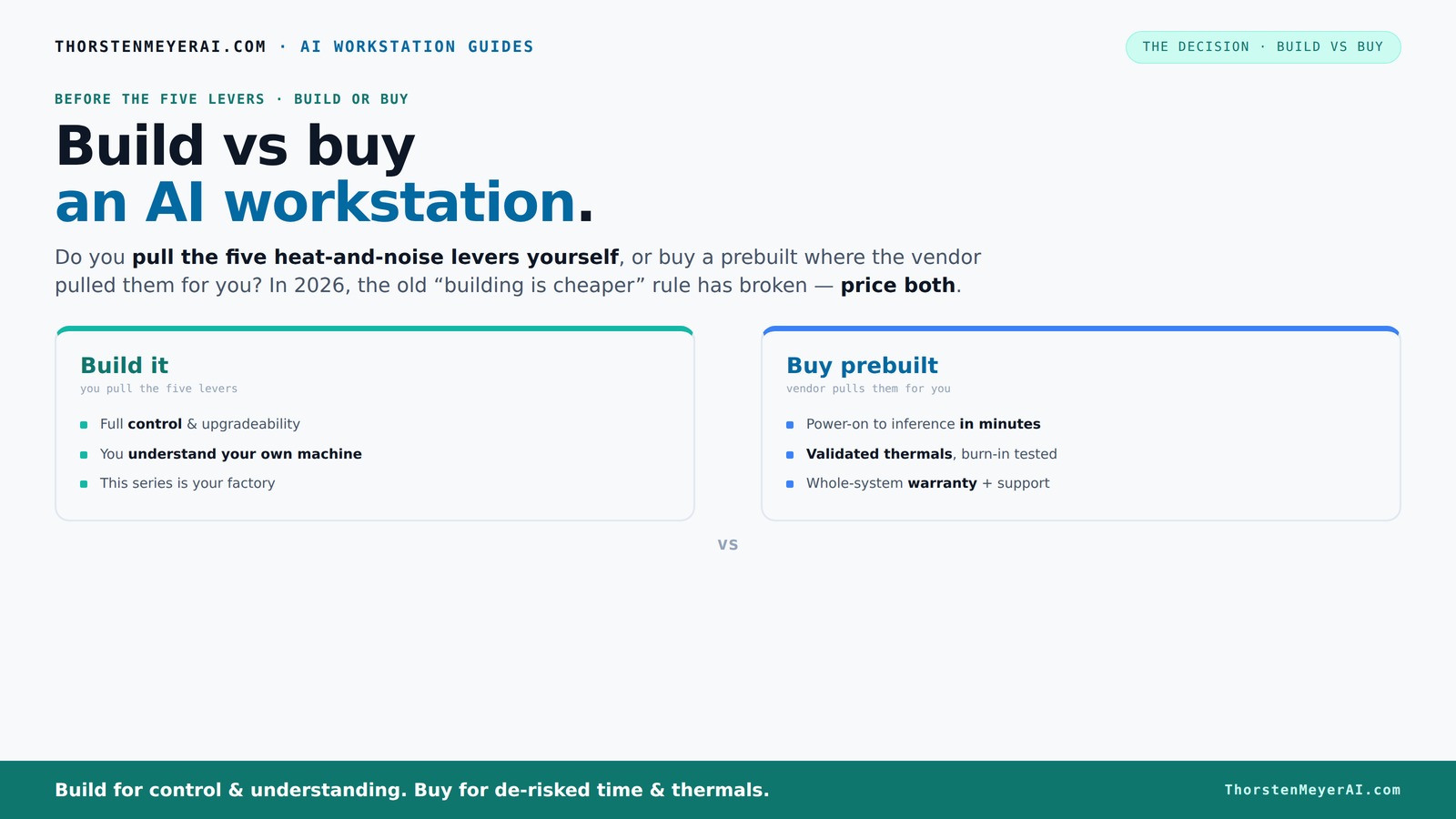
The real question behind this whole series: do you pull the five heat-and-noise levers yourself, or buy a prebuilt where the vendor pulled them for you? And in 2026, the old “building is cheaper” rule has broken. Match your situation in Part 3.
Why Building Your Own AI Workstation Is No Longer Always Cheaper
Building your own AI workstation used to be the clear winner on cost. But in 2026, that’s no longer true. Component shortages and bulk buying have driven prices up for key parts like GPUs, DDR5 RAM, and SSDs. For example, a DIY build that used to cost $1,000 now often hits $1,250 or more. Meanwhile, prebuilt vendors, who bought parts in bulk before prices spiked, can offer systems at prices that are hard to beat.
More importantly, this shift impacts your decision-making process. When component costs rise, the traditional advantage of DIY—cost savings—shrinks or disappears. It also introduces new considerations: if you’re paying nearly the same or more for a custom build, are you sacrificing time and flexibility for minimal savings? Additionally, the risk of sourcing incompatible or suboptimal parts increases, which can lead to delays and additional costs. This makes the choice more about strategic value—speed, reliability, and future upgrade paths—rather than just initial price.
Therefore, in 2026, understanding the economic landscape isn’t just about comparing sticker prices; it’s about evaluating which approach aligns better with your project timelines, risk tolerance, and long-term goals. The tradeoff is increasingly about convenience and certainty versus potential savings, which may no longer be significant.
As an affiliate, we earn on qualifying purchases.
The Heat and Noise Levers: Who Pulls Them?
Making an AI workstation run cool and quiet is a complex dance of five levers: undervolting the GPU, matching the cooler, optimizing airflow, tuning fans, and proper placement. Learn more about cooling solutions. When you buy a prebuilt, the vendor pulls these levers for you. Companies like Lambda or BIZON test and validate thermal and acoustic performance before shipping, often including water cooling for quieter operation.
Build it yourself? That’s your job. You choose a quiet GPU, undervolt it, pick a case with sound-dampening features, and fine-tune everything. It’s a satisfying project, but it takes time, expertise, and patience. The tradeoff: convenience and guaranteed performance versus tailored control and learning.
Why does this matter? Because thermal and noise management directly impact your system’s longevity, performance stability, and user experience. A poorly cooled system may throttle under load, reducing performance and risking hardware failure. Excessive noise can also be distracting, especially in shared or office environments. Prebuilts often come with optimized cooling solutions tested for stability and noise levels, which means less guesswork and fewer surprises. DIY setups, while customizable, require ongoing adjustments and monitoring to achieve similar results, making the process more hands-on but potentially more rewarding for enthusiasts.
As an affiliate, we earn on qualifying purchases.
When a Prebuilt AI Workstation Makes Sense
If you need to get up and running fast, prebuilt is often the way to go. You can also explore recipes and techniques for optimizing your system setup. Systems come with the OS, drivers, and AI tools like CUDA or TensorFlow preinstalled. That means you can start training or inference almost immediately.
For example, a business deploying multiple AI servers might prefer a vendor like Puget or Lambda, who run 24–48 hours of stress testing and validation. They also handle warranty support, making downtime less painful. This is ideal if your time is more valuable than the slight premium for convenience.
Beyond speed, prebuilt systems offer a level of reliability and consistency that’s hard to match with DIY. Vendors test their systems thoroughly, ensuring thermal and power stability, which reduces the risk of hardware failures during critical operations. Additionally, prebuilt solutions often include professional support and warranty services that can quickly resolve issues, minimizing costly downtime. For organizations or individuals who cannot afford the learning curve or time investment of building from scratch, this reliability is a significant advantage. It allows you to focus on your AI projects rather than troubleshooting hardware issues.
As an affiliate, we earn on qualifying purchases.
When Building Your Own AI Workstation Is Still the Right Move
If you love tinkering or need a system tailored exactly to your workload, building your own rig remains appealing. You control every component — from the GPU brand to the cooling method. Want a silent PC? You pick a quiet CPU cooler and case. Need a specific RAM configuration? Done.
For example, a researcher customizing a dual-GPU system for deep learning might choose a specific water-cooling setup and proprietary motherboard. They gain control over power management and future upgrades, extending the system’s lifespan.
But beyond customization, building your own system can be a strategic choice for cost savings—if you have the skills to optimize each component and source parts at good prices. It also offers an educational benefit: understanding your hardware deeply, which can help in troubleshooting and future upgrades. However, this approach requires patience, technical knowledge, and time investment. The tradeoff is that you might spend more initial effort for potentially better control, but the risk is making costly mistakes if you’re inexperienced. For those who value hands-on control, learning, and potential long-term savings, DIY remains a compelling option despite the challenges.
As an affiliate, we earn on qualifying purchases.
Frequently Asked Questions
Is a prebuilt AI workstation worth the extra cost?
For many, yes. Prebuilts save time, come with validated thermals, and include support, which can reduce costly downtime. If your priority is rapid deployment and reliability, the added expense is often justified.
Will a prebuilt perform as well as a custom build for my AI workload?
Generally yes. Vendors optimize prebuilts for AI tasks, often including factory-tuned cooling and power management. In many cases, they outperform DIY setups that lack rigorous testing.
What parts matter most for AI work: GPU, CPU, RAM, cooling?
The GPU is king for AI workloads, followed by ample RAM and fast storage. Cooling and power delivery are critical for sustained performance, especially in multi-GPU systems. Proper thermal management prevents throttling and prolongs hardware life.
Are prebuilts easier to upgrade later?
Usually yes, if they use standard, off-the-shelf parts. However, some OEM prebuilts incorporate proprietary components that can complicate future upgrades or repairs. Always check the vendor’s upgrade policy.
How much do I save by building myself?
It depends on your hardware choices and skills. In 2026, component prices have risen, narrowing the gap. If you’re experienced and can source parts cheaply, building can still be cheaper—otherwise, prebuilts often match or beat DIY costs.
Conclusion
There’s no one-size-fits-all answer anymore. The decision to build or buy hinges on your priorities: do you want control and customization, or speed and support? In 2026, the smart move depends on your workload, budget, and patience for the process.
Remember, component shortages have leveled the playing field — sometimes favoring prebuilts. So, check your exact needs, compare prices, and weigh the time vs control tradeoff. After all, your AI journey shouldn’t be delayed by hardware hassles.
Halloween Picks
halloween
As an affiliate, we earn on qualifying purchases.